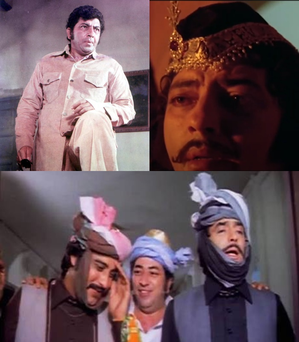
New Delhi, Nov 12 (IANS) It was a spellbinding moment that no camera could do justice to. This Bollywood actor, who had made his name as a mealy-mouthed, sadistic, and vicious brigand, now played a cultured yet hapless Nawab and on the first shot itself, lost control of himself as he crooned a simple but sad couplet with the melancholic light of a setting sun defining his face, leaving the director emotional too.
As Amjad Khan, playing Nawab Wajid Ali Shah in “Shatranj Ke Khiladi” (1977), recited: “Jab chhorh chale Lucknow nagri/Kahein haal ke hum par kya guzri…”, even Satyajit Ray’s eyes grew moist, screenplay writer Shama Zaidi recalled.
He also delivered one of the funniest dialogues of Hindi films in the same film. As his wazir Madar-ud-Daula (Ali Naqi Khan), played by Victor Banerjee, silently weeps after coming from meeting the British resident where he is told the Nawab must abdicate, Wajid Ali Shah comes on him silently and asks him what had happened. As he keeps on weeping, the ruler asks:” Kya huya, Resident sahab ne koi ghazal to nahi suna di?”
Despite being branded by his role in “Sholay” (1975) and a villainous ‘heavy’ in several other Bollywood movies – usually opposite Amitabh Bachchan, Amjad Khan (1940-92), who was born on this day (November 12), had much more to his oeuvre than just being Gabbar Singh.
Satyajit Ray had his eye on him ever since he conceived of what would become his sole Hindi film. Journalist-turned-scriptwriter Javed Siddiqi, who had been roped in for the project, wrote that when he first met Ray, he found that the legendary filmmaker had made sketches of Khan in the role of the Nawab, noting their uncanny resemblance. .
Ray’s wife, Bijaya, was also impressed by Khan. Recalling a time when he came to their house for dinner, she, in her autobiography “Manik And I, My Life with Satyajit Ray” (2012) termed Khan a “wonderful man”, who “spoke charmingly and was very well-educated too”. “Manik and he found many things to discuss, and time just flew,” she wrote.
And then, Gabbar Singh was not Khan’s sole contribution to “Sholay”.
He was tasked with liaising with the Hollywood technicians that director Ramesh Sippy had flown in for the action scenes – as he was the most fluent English talker on the sets. However, actor Sachin Pilgaonkar, who played a cameo, recently revealed that he and Khan had been the directors of most of the film, as Sippy concentrated only on the scenes featuring the top actors.
But Gabbar Singh and Khan’s other notorious roles – volatile criminal Dilawar in “Muqaddar ka Sikandar” (1978), sinister criminal Vikram in “Mr Natwarlal” (1979), Damodar aka Damu of “Naseeb” (1981), the covetous and murderous uncle in “Satte Pe Satta” (1982) and many more, overshadowed his forte for more positive and even comic roles.
Take the wisecracking, drum-playing police inspector – named Amjad Khan – in “Qurbani”, the foster father of Sanjay Dutt in his debut “Rocky”, Ranvir Singh of “Laawaris”, the hero’s affluent and supportive friend Bishan in “Yaarana” (all 1981), affable police constable Sher Singh in “Love Story” (1982), Vatsyayan (of “Kama Sutra” fame) in “Utsav” (1984), feckless prince Vishwanath of fantasy “Pataal Bhairavi” (1985), and helpful advocate Harish of “Chameli ki Shaadi” (1986), among others.
Son of veteran character actor Jayant (Zakariya Khan), most known as Balraj Sahni’s Pathan friend in “Garam Coat” and the Brigadier in that grim war film “Haqeeqat” (1964), Khan was drawn into acting from his very childhood.
Even before doing theatre during his college days in Bombay, he had an uncredited role as a child artiste in romantic fantasy “Nazneen” (1951), starring Madhubala, Nasir Khan (the younger brother of Dilip Kumar) and his father. After a minor part in Raj Kapoor’s “Ab Dilli Dur Nahin” (1957), his first adult film appearance was again an uncredited role, as a gang member in “Maya” (1961), starring Dev Anand, and then, a cameo as a Pakistan Air Force officer in war thriller “Hindustan ki Kasam” (1973).
Though Javed Akhtar, who had seen Khan on stage, thought of him as perfect for Gabbar Singh and partner Salim Khan agreed, the duo later did not appreciate his performance and even tried to get him changed. Khan was furious when he learnt of this later, and never worked with them again.
However, in 1976, Khan’s career – and life – nearly came to a premature end when he, and his wife, were severely injured in a road accident on the Goa-Bombay highway. It was Amitabh Bachchan who signed the consent form for his emergency surgery and while he recovered, his health had been affected. He began putting on weight, leading to a fatal heart attack in 1992.
(Vikas Datta can be contacted at vikas.d@ians.in)