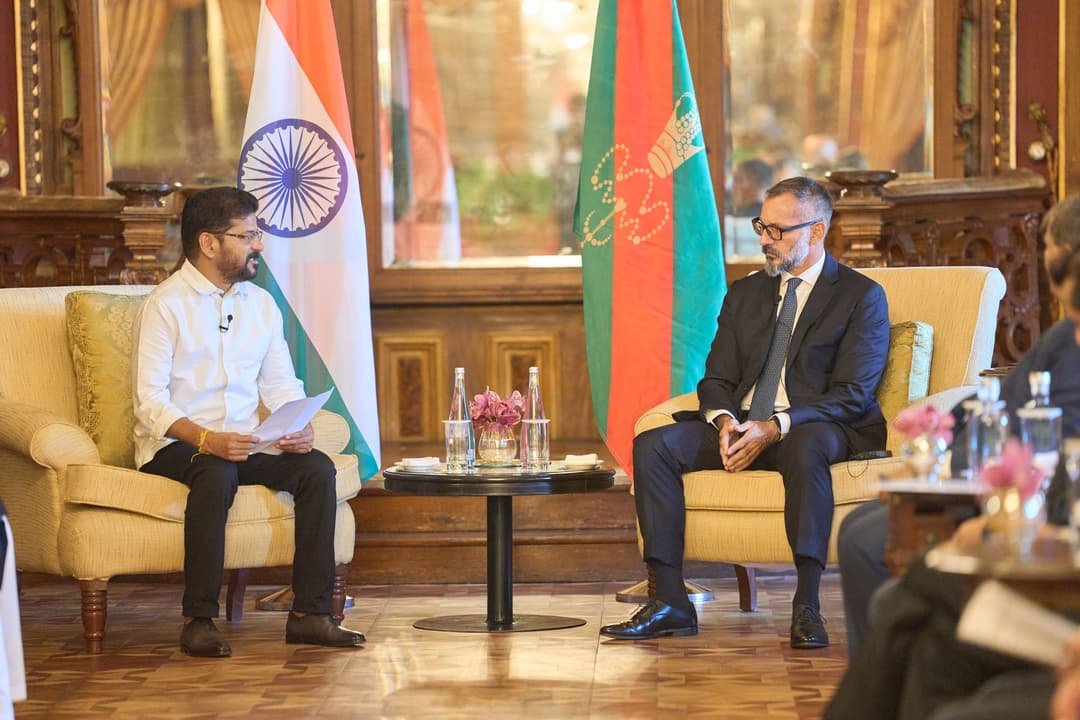
Hyderabad, Dec.10 (RAHNUMA): The University of Hyderabad (UoH), under its Institute of Eminence (IoE) initiative, hosted a distinguished lecture by Prof. Raghu Kalluri, chairman, Department of Cancer Biology, University of Texas MD Anderson Cancer Center. The session, held at the School of Life Sciences auditorium, drew faculty, researchers, students and officials, and was presided over by Vice Chancellor Prof. BJ. Rao.
Delivering the lecture, Prof. Rao said the IoE initiative enabled UoH to bring globally acclaimed scientists to the campus, strengthening academic exchange and interdisciplinary research. The IoE leadership underscored the role of strong research infrastructure and global collaborations in advancing cutting-edge science.
Dean of Life Sciences Prof. Anand K. Kondapi highlighted the School’s growth and its research strengths in cancer biology, metabolic diseases, plant sciences and interdisciplinary studies.
Delivering his talk titled “Cancer Without Disease: Combining Healthy Living, Aging and Strategies for Cancer Prevention”, Prof. Kalluri drew from his 37 years of experience to explain the biology of cancer, immunity and aging. He noted that while cells routinely experience damage, most of it is repaired — but mutations that escape repair can accumulate over 15 – 20 years and eventually transform into cancer. The p53 gene, often called the “guardian of the genome”, is the most frequently mutated in cancers, he said.
Prof. Kalluri explained how silent lesions in organs such as the breast and thyroid can remain undetected for years, and how cellular abnormalities like aneuploidy do not always lead to disease.
Citing National Cancer Institute findings, the professor emphasized that although cancer is fundamentally a genetic disease, the human body has remarkable capacity to contain mutations and prevent them from progressing to clinical illness. Only a fraction of age-related mutations result in invasive cancer.
Prof. Kalluri stressed the critical role of immune surveillance, noting that the decades-long window between mutation and malignancy allows the immune system to eliminate or suppress abnormal cells.
Healthy aging, efficient DNA repair, reduced inflammation and metabolic balance — often termed anti-aging mechanisms — serve as powerful cancer-preventive strategies, he added.
He highlighted emerging insights into key molecular drivers such as ‘KRAS’ in pancreatic cancer, and described how collagens and fibrosis shape the tumor microenvironment. He reiterated that up to 35% of people over 40 may harbor contained, non-invasive cancers that never progress to disease — a phenomenon he termed “cancer without disease”.
The lecture called for rethinking cancer prevention by focusing on long-term immune resilience and healthy aging rather than only aggressive treatment approaches. UoH reaffirmed its commitment to expanding interdisciplinary research and hosting globally significant academic events under the IoE framework.