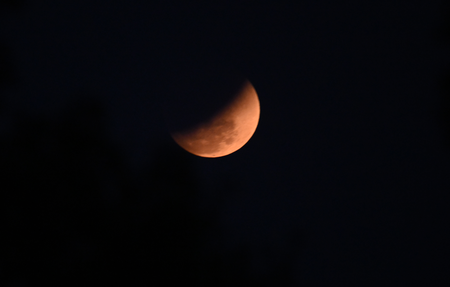
Bhopal/New Delhi, March 3 (IANS) Skywatchers around the world witnessed a spectacular “total lunar eclipse”, popularly known as a “Blood Moon” due to the Moon’s striking reddish hue during totality.
In India, the event was eagerly awaited as “Chandra Grahan”, marking the first lunar eclipse of the year and coinciding with cultural significance, including preparations for festivals like Holi in some traditions.
A lunar eclipse occurs when the Earth positions itself directly between the Sun and the Moon, casting its shadow across the lunar surface.
During a total eclipse, the Moon fully enters the Earth’s umbral shadow, filtering sunlight through the atmosphere and scattering shorter blue wavelengths, leaving longer red ones to bathe the Moon in a coppery glow—hence the “Blood Moon” moniker.
For observers in India, the eclipse began at 3:20 p.m. with the penumbral phase, when the Moon subtly entered the Earth’s outer shadow. The partial phase followed, leading to totality. However, since the eclipse started in the afternoon, the Moon was below the horizon in India during much of the early stages.
Visibility commenced only after moonrise around 6:26 p.m., allowing viewers to catch the later phases, including the tail end of totality and the maximum eclipse effect. The peak visibility window in India spanned from 6:33 p.m. to 6:40 p.m., when the Moon appeared dramatically reddened low on the eastern horizon. The entire eclipse concluded by 6:47 p.m. The total duration was approximately 3 hours and 27 minutes, while totality itself lasted about 58 minutes globally.
In many parts of India, especially central and western regions like Indore, the Moon rose during or just after the maximum phase, offering a breathtaking view of the eclipsed Moon tinged in red-orange hues against the twilight sky.
Northeastern areas and islands may have glimpsed more of the totality phase. No special equipment was needed—naked-eye viewing sufficed, though binoculars or telescopes enhanced details like subtle lunar features.
Culturally, the event prompted observance of ‘Sutak Kaal’, a traditional inauspicious period in Hindu customs. Sutak began around 6:20–6:23 a.m. (or later in some panchangs, like 9:39 a.m. and ended with the eclipse’s conclusion around 6:46–6:47 p.m. During this time, many avoided auspicious activities, temple visits were restricted in places like Tirupati, and people followed rituals such as fasting or eating sattvic foods.
This total lunar eclipse was the last until late 2028, making it a rare treat. Enthusiasts shared stunning photos of the Blood Moon rising, capturing the celestial wonder that blended science and tradition seamlessly.