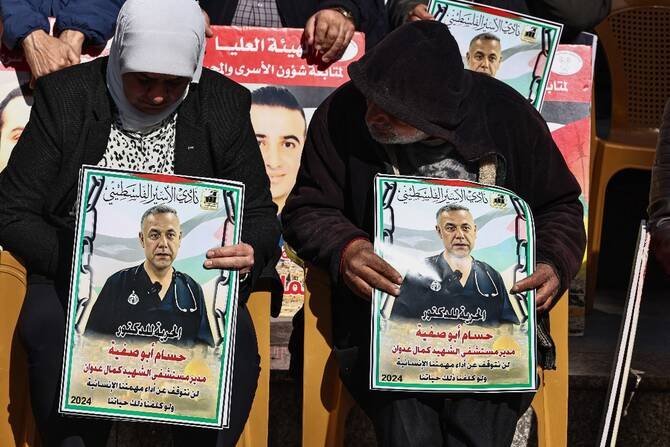
DUBAI(RAHNUMA): For more than a year, the family of detained Gaza doctor Hussam Abu Safiya has clung to the hope of seeing him again, sparing no effort to campaign for his release.
But after Israel approved the death penalty for Palestinians accused of terrorism last week, his family says that hope is beginning to fade.
“We flinch at the sound of every phone call and every update from Gaza. We fear that every word might carry the end,” his eldest son, Elias Abu Safiya, told Arab News on WhatsApp from Kazakhstan.
“We live every moment like it’s the last. We don’t want these decisions to turn into a final goodbye.”
Hussam Abu Safiya, a pediatrician and director of Kamal Adwan Hospital in northern Gaza, became a prominent voice during the war, documenting Israeli attacks on medical facilities that he said were putting patients, medics and sheltering displaced civilians at risk, and calling for the international community to protect the healthcare system.
The 52-year-old father of six fell silent on Dec. 27, 2024, when Israeli forces arrested him after he refused to leave Kamal Adwan Hospital — the last functioning hospital in besieged northern Gaza at the time — despite evacuation orders, choosing instead to remain and treat wounded children and patients.
An image of Abu Safiya walking in a white doctor’s coat through a rubble-strewn street toward an Israeli tank made headlines around the world and was widely believed to capture the final moments before his arrest.
Since his arrest, Abu Safiya has been denied family visits, with his children relying on rare updates from lawyers and former detainees to learn about his condition inside Israeli prisons.
Elias said his father is now being held in the notorious Nafha desert prison without trial or formal charge and has been barred from meeting his lawyer for more than 50 days under what authorities described as security conditions linked to the Israeli-US war with Iran.
“We don’t know anything about him for the last 50 days,” Elias, 28, told Arab News.
“We ask ourselves every day: How is he? Is he in pain? Is he eating? Does he find anyone to console him? Does he feel that we, as a family, are with him despite all this distance?”
On March 24, UN experts called for Abu Safiya’s immediate release and demanded that he be granted access to medical examination and treatment after receiving reports that he had been subjected to “severe torture.”
They warned that “his health condition remains dire” and that he was facing “cruel and degrading treatment.”
Elias’ last image of his father was similar to the one the world saw — he was in a white coat. They were inside Kamal Adwan Hospital, where the family, like many others, had been sheltering after repeated displacement.
“My father told us to leave when my brother Idris was shot next to his heart by a sniper.”
Elias and several of his siblings, who hold Kazakh citizenship, were evacuated in February 2024, four months into the war, with the help of Kazakhstan’s Foreign Ministry and embassy.
His 21-year-old brother Ibrahim, who remained in Gaza with extended family members, was later killed during an Israeli offensive on the hospital. Some relatives were arrested along with Abu Safiya before being released later, Elias said.
Despite the war, the family remained in intermittent contact with him while he was still at the hospital.
“During our last interactions, I kept begging him to leave the hospital,” Elias said. “But he insisted he would stay true to the oath he took as a doctor and hospital director and would not leave the wounded children behind.”
About a month after his arrest, Israel alleged, without publicly providing evidence, that Abu Safiya had been involved in “terrorist activities” and held “a rank” in Hamas that made Kamal Adwan Hospital a stronghold during the war.
Elias denied these allegations.
“The lawyer informed us that his case record is clean. The Israeli public prosecution did not find evidence to support the terrorism allegations and, until today, has not filed any formal charges against him,” Elias said.
“My father’s only crime was his determination to stay in the hospital despite evacuation orders and provide care for people who had no one else to support them. He rescued over 187 wounded children.”
In a statement, Amnesty International described Abu Safiya’s detention as “arbitrary” and said it reflected what it called Israel’s “systematic targeting of Palestinian health workers and the decimation of the healthcare system in Gaza.”
The organization said his lawyer reported that Abu Safiya and other detainees had been subjected to assault and beatings, and that the doctor showed signs of significant weight loss.
Elias confirmed that his father was subjected to torture and denial of access to medical care and food.
According to Healthcare Workers Watch, about 85 healthcare workers remain in Israeli custody, many without charges, while six are known to have died in detention since the war began on Oct. 7, 2023.
Medical Aid for Palestinians said at least 1,722 medical workers were killed between October 2023 and October 2025.
The Israeli war has damaged all 36 hospitals in Gaza, with only about half partially functional, according to the World Health Organization.
Abu Safiya’s family is now urging the international community to intervene and help ensure that Palestinian detainees are granted their basic rights.
“Behind every hostage, there is an entire family who sleeps in fear and wakes up every day looking for a glimmer of hope,” Elias said.
“Hostages must be granted their right to live. Behind every hostage, there is a mother waiting for her child, a wife dreaming about the return of her partner, and children asking when their father will return. And tears are our only answer.”