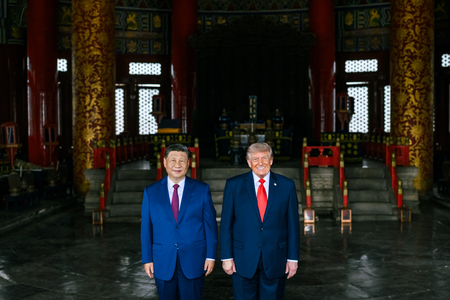
Beijing, May 15 (IANS) When US President Donald Trump and Chinese President Xi Jinping met in Beijing this week, their cordial exchange of pleasantries, a firm handshake and emphasis on cooperation fueled cautious optimism about relations between the two superpowers.
However, a lack of major breakthroughs on complex issues, including the status of Taiwan, underscored the persistent challenges facing the Sino-US relationship amid increasingly rancorous competition over trade, security and technological leadership.
Above all, the latest Trump-Xi summit drove home one clear message: The leaders of the world’s most powerful nations remain on speaking terms and plan to meet several more times this year alone, including during Xi’s anticipated reciprocal visit to Washington in September, Yonhap news agency reported.
“When there were difficulties, we worked it out. I would call you, and you would call me,” Trump said at the start of the talks with Xi on Thursday. “Whenever we had a problem, we worked it out very quickly, and we are going to have a fantastic future together.”
Xi struck a cooperative tone, stressing that the United States and China should be “partners, not rivals.”
“China and the United States both stand to gain from cooperation and lose from confrontation,” he said in his remarks translated through an interpreter.
“We should help each other succeed and prosper together, and find the right way for major countries to get along well with each other in the new era.”
Friday’s summit venue, Zhongnanhai, added to the mood for Sino-US cooperation.
Zhongnanhai is the central complex of the top Chinese leadership. Situated close to the Forbidden City, it was where then US President Richard Nixon met then Chinese leader Mao Zedong in 1972 to lay the groundwork for Sino-US detente.
Despite the cooperative atmosphere, the summit brought renewed attention to long-running geopolitical fault lines between Washington and Beijing, including Taiwan, the self-governing democracy that China considers part of its territory.
Xi warned during Thursday’s summit that if the Taiwan question is mismanaged, the two countries may end up having “clashes” and “even conflicts,” according to Xinhua News Agency.
In an interview with Fox News, Secretary of State Marco Rubio, who doubles as Trump’s top National Security Advisor, said “it is not in China’s interest or anyone’s interest for there to be any sort of forced change in the status quo” regarding Taiwan.
“I think stability there is very important,” the Secretary said.
In the lead-up to Trump’s China trip, speculation had lingered that the Trump administration could consider a shift in US policy language to “opposing” Taiwan’s independence from “not supporting” it.
On Iran, the two sides found some common ground, though they diverged on China’s purchase of Iranian oil.
The US and China agreed at the summit that Iran can never have a nuclear weapon, and that the Strait of Hormuz, a crucial shipping route for oil, fertiliser, and other commodities, must remain open to support the free flow of energy, according to a White House official.
Moreover, Trump told Fox News that Xi had offered to help broker an end to the war with Iran and keep the strait open, according to Yonhap.
“We feel very similar on Iran,” Trump said during the Zhongnanhai meeting with Xi.
But Trump said in the Fox News interview that Xi told him China intended to continue buying oil from Iran. The Trump administration has wanted Beijing to halt its purchases of Iranian oil, a key source of revenue for the Tehran regime, as part of its pressure campaign against Tehran, according to the report by Yonhap.
It remains unclear whether Trump and Xi touched on North Korea’s advancing nuclear and missile programs, though China’s state media said they discussed key regional and international issues, including those concerning the Korean Peninsula.
Ahead of the Beijing summit, expectations had arisen that North Korea could be brought up at the Trump-Xi summit, as the US president has repeatedly expressed his desire to re-engage with North Korean leader Kim Jong-un since his second term began early last year.
On trade, Trump said he and Xi made “some fantastic trade deals” that are “great for both countries.”
He did not elaborate, but Trump told Fox News that China committed to purchasing US soybeans, oil and liquefied natural gas, as well as 200 Boeing jets, noted the report.
Aside from the purchase commitments, there was no announcement on how the two sides will deal with their temporary trade truce set to expire later this year, as the Trump administration is conducting trade investigations into China and other countries, which could result in new tariffs.
During the Trump-Xi summit in South Korea in late October, the two sides reached a one-year truce aimed at lowering existing tariffs and suspending further trade restrictions, including China’s export curbs on rare earth elements.
China’s accelerating nuclear buildup was expected to be part of the leaders’ discussions, but there was no word on whether the leaders discussed the security issue.
Trump has shown his interest in forging a new arms control treaty that includes China, after the New Strategic Arms Reduction Treaty between the US and Russia, known as the New START, expired in February.
China’s nuclear stockpile has been growing at an alarming pace from the US perspective. China’s stockpile of nuclear warheads remained in the low 600s in 2024, and its military remains on track to possess over 1,000 warheads by 2030, according to a 2025 Pentagon report on China’s military developments.