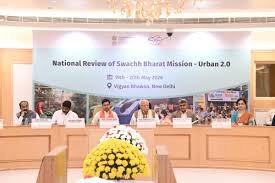
New Delhi, May 19 (RAHNUMA): Deputy Chief Minister Bhatti Vikramarka attended the two-day national review meeting on “Swachh Bharat Mission–Urban 2.0” inaugurated by Union Minister for Housing and Urban Affairs Shri Manohar Lal Khattar at Vigyan Bhavan, New Delhi on Tuesday. The meeting was organised to strengthen urban sanitation, cleanliness and solid waste management systems across the country.
On the first day of the meeting, extensive discussions were held on urban cleanliness, sanitation, solid waste management, door-to-door waste collection, scientific processing of waste, remediation of legacy dump sites, waste-to-energy projects, PPP models and implementation of the new Solid Waste Management Rules. States and cities also shared their best practices and experiences in urban waste management.
Addressing the meeting,Bhatti Vikramarka explained the scientific waste management systems, sustainable urban development initiatives, sanitation programmes and circular economy measures being implemented in Telangana.
He stated that under the leadership of Chief Minister Revanth Reddy, the Telangana government is working towards building a sustainable, inclusive and environmentally responsible future in line with Telangana Vision–2047. He said the State is following the development framework of CURE, PURE and RARE, giving equal importance to the balanced growth of Core Urban Regions, Peri-Urban Regions and Rural Agricultural Regions.
The Deputy Chief Minister observed that solid waste management is no longer limited to waste collection alone, but is directly linked to climate response, environmental sustainability, circular economy, employment generation and economic productivity. He said the recently introduced Solid Waste Management Rules–2026 by the Central Government are bringing transformative changes in the country’s waste management ecosystem.
He explained that the new rules focus not only on conventional waste collection and dumping, but also on 4-way source segregation, decentralised waste processing, scientific remediation of old dump yards, waste-to-energy generation, technology-based monitoring, circular economy practices, ward-level accountability and public participation. Telangana, he said, had already initiated several such reforms even before the rules formally came into effect.
The Deputy Chief Minister informed that Telangana government is introducing around 9,596 electric Swachh Auto Tippers in core urban regions. These electric vehicles will help reduce carbon emissions from municipal operations and promote cleaner transportation systems. He said the vehicles are being designed with separate compartments to facilitate 4-way source segregation and QR-code based monitoring for efficient door-to-door waste collection.