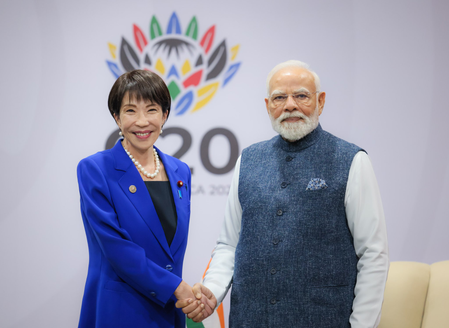
New Delhi, July 1 (IANS) From Security And Growth for All in the Region (SAGAR) to Mutual and Holistic Advancement for Security and Growth Across Regions (MAHASAGAR), India’s maritime vision has grown into a leadership position, which resonates with Japan’s Free and Open Indo-Pacific (FOIP) framework, as said by Prime Minister Sanae Takaichi herself in a recent article.
Together, the initiatives of two Premiers represent a democratic axis in the Indo-Pacific that blends security with development, and deterrence with inclusivity.
In a world order marked by uncertainty, India and Japan are betting that their converging visions will not only secure the seas but also empower nations across the Global South to chart their own course.
Outlining India’s policy towards the Indian Ocean Region (IOR), Prime Minister Narendra Modi first articulated SAGAR in March 2015 while commissioning the offshore patrol vessel Barracuda, built in Kolkata’s Garden Reach in Mauritius.
It was a maritime outreach strategy aimed at ensuring stability and prosperity in the Indian Ocean Region (IOR).
Prime Minister Modi described SAGAR as India’s commitment to act as a “net security provider” and to uphold trust, transparency, and peaceful resolution of maritime disputes.
A decade later, in March 2025, when Prime Minister Modi returned to Mauritius, he unveiled MAHASAGAR. This expanded vision reflects India’s ambition to move beyond the Indian Ocean and position itself as a leader of the Global South, offering a framework that blends security with development, trade, and sustainability.
Interestingly, in several Indian languages, “Sagar” means sea, and “Mahasagar” the ocean.
The use marks a strategic evolution from a regional focus on the Indian Ocean to a global maritime vision, with particular emphasis on the Global South, as was pointed out earlier by Suchitra Durai, former Ambassador of India to Thailand.
Prime Minister Modi’s engagements with Mauritius, Maldives, Trinidad and Tobago, Ghana and the Philippines, are aligned with the MAHASAGAR vision, she opined.
Incidentally, Prime Minister Sane Takaichi’s article aligns her FOIP vision with her Indian counterpart Narendra Modi’s initiative.
According to Takaichi, a genuinely free and open region is not one where only the great powers enjoy freedom but one where every nation is able to chart its own course of its own free will, unswayed by external coercion.
She praised India as an indispensable partner, noting that India is a maritime nation that has taken concrete action to provide regional stability and support the resilience of countries in the area.
Her words underscore a convergence, where Japan’s FOIP emphasises rule of law and freedom of navigation, and India’s MAHASAGAR adds a developmental dimension.
Together, they present a democratic counter-narrative to China’s Belt and Road Initiative (BRI) and its “String of Pearls” encircling strategy in the Indian Ocean.
The Indo-Pacific is the geopolitical theatre of the 21st century. China’s assertiveness, whether through military expansion in the South China Sea or infrastructure diplomacy in South Asia, has unsettled smaller nations.
Even the United States, being influential, is still recalibrating its commitments. This creates space for middle powers like India and Japan to step up.
For India, MAHASAGAR will establish its role as a responsible power, balancing hard security with soft power. For Japan, FOIP ensures that democratic values and freedom of navigation remain central to regional order.
And for the Global South overall, MAHASAGAR and FOIP offer alternatives to dependency on China, emphasising partnership and autonomy.
India and Japan friendship has a long history of association, with strong cultural and civilisation ties.
In the recent past, the relationship has transformed to a partnership of great substance and purpose.
Regional and broader international ties include the Asia-Africa Growth Corridor (AAGR), and defence ties like the Quadrilateral Security Dialogue, a strategic dialogue that also include the United States and Australia.
In the former instance, India and Japan are already collaborating on projects in countries like Bangladesh, Myanmar, Sri Lanka, and some African nations.
As Japan’s FOIP and India’s MAHASAGAR converge, the Indo-Pacific may witness a new axis of cooperation — one that blends security with development, and deterrence with inclusivity.
In a world order marked by uncertainty, India is betting that its expanded vision will not only secure the seas but also win the trust of nations across the Global South.