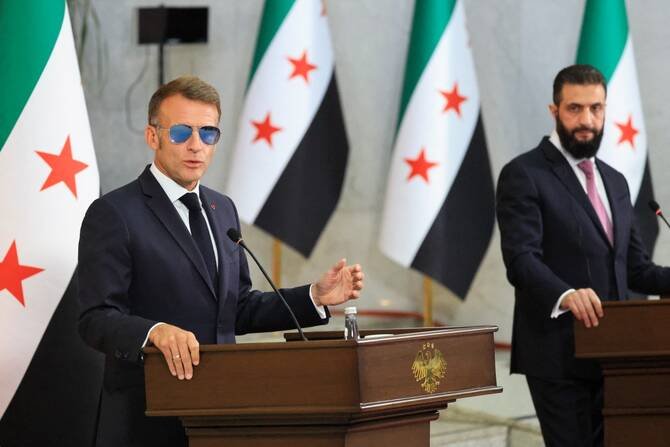
LONDON(RAHNUMA): French President Emmanuel Macron’s visit to Damascus is being widely hailed as historic, making him the first European Union leader to visit Syria since the ouster of longtime ruler Bashar Assad in late 2024.
For a country emerging from about 14 years of war, diplomatic isolation and economic freefall, the symbolism might be unmistakable. But the visit also raises a pressing question: What does France stand to gain from closer ties with Damascus?
For some analysts, France’s push to restore diplomatic ties and support Syria’s recovery is hardly surprising.
“It is not surprising that France is the first European country to reengage with Syria after Assad’s fall,” Hussam Hammoud, a Syrian journalist and geopolitical analyst, told Arab News.
He said France was the first European country to welcome Ahmad Al-Sharaa in May last year and had encouraged talks between Syria and Israel.
“France is trying to play the main role inside the European Union, and also on behalf of the EU more generally,” Hammoud said.
In his view, Macron’s visit builds on that strategy. “France is implementing US trends, peace deals with Israel and encouraging economic investment,” he said.
Indeed, although France has not played a formal role in talks between Syria’s interim government and Israel, it has hosted meetings in Paris and backed the US-led dialogue.
In February, French Foreign Ministry spokesperson Pascal Confavreux told the Syrian outlet Enab Baladi that Paris was trying to reassure Israel that Syria would not pose a future threat.
Hammoud said France’s approach largely mirrors Washington’s.
“If we consider the relationship between the US and France within EU policy, we can see the link between both,” he said. “I think there is also coordination between the US and France to promote the new Syria and the new Syrian leadership.”
Others, however, say France’s role should not be overstated.
Benjamin Feve, a senior consultant at Karam Shaar Advisory, called Macron’s visit “politically significant” but said symbolism has yet to translate into real leverage.
“For Syria, France offers legitimacy, a kind of European gateway, and diplomatic value,” Feve told Arab News. “For France, the gains are regional influence, security coordination, some influence in Lebanon, counter-terrorism, and possibly commercial positioning.”
Still, he noted that Damascus now has other partners with stronger leverage.
“In the push to lift sanctions on Syria, the key actors were the United States and Saudi Arabia, with Riyadh’s close relationship with Washington helping shape that process before the Europeans followed,” Feve said.
“At this stage, Damascus has more influential partners than France,” he added. “This is very different from 15 or 20 years ago, when Syria was far more isolated and (former French President) Nicolas Sarkozy helped lead a rapprochement between Damascus and the West.
“Today, Syria is far more connected to and integrated within the international community, so France’s role is less significant than it once was.”
Even so, Feve said France moved earlier than most Western governments and scored symbolic wins.
“Obviously, it moved very early and very symbolically,” he said. “You can recall Macron’s call with Ahmad Al-Sharaa, which I think was the first call from a European head of state directly to Al-Sharaa. There was also (Al-Sharaa’s) Paris visit, which was his first visit to the EU.”
Macron called Al-Sharaa in February 2025 to congratulate him after he assumed the presidency in late January, becoming the first EU head of state to speak directly with Syria’s new leadership.
But Feve said France has yet to convert that early engagement into major political or economic gains. “France has not truly converted that symbolism into concrete influence or major advantages for French companies.”
He pointed to French shipping giant CMA CGM, which is “well positioned in Syria but predates Assad’s fall,” The company has operated in the country for about 15 years.
In May 2025, CMA CGM signed a 30-year contract to operate the port of Latakia. It had managed the port’s container terminal since 2009 under Assad under a previous agreement that was renewed several times.
Feve also pointed to TotalEnergies, though he said its ambitions in Syria remain preliminary.
“You also have the deal with Total, but that has yet to materialize,” he said. “They’ve signed agreements and contracts, but it remains to be seen.”
That interest was on display during Macron’s visit. TotalEnergies CEO Patrick Pouyanne, who traveled to Damascus with the French president, said Syria could become an important transit country linking Iraq to the Mediterranean, offering alternative routes to the Strait of Hormuz amid regional tensions.
“Today, it’s clear that the security situation still doesn’t allow us to operate, but I think it is a positive initiative to come here, to Damascus,” he told reporters shortly before reports emerged that two bombs exploded near the hotel where Macron had spent the night, AFP reported.
In May, Total signed a memorandum of understanding with the Syrian Petroleum Co. to explore an offshore block in the Mediterranean. Pouyanne said he would hold talks with Syrian counterparts on the possibility of moving toward a contract, Reuters reported.
For other analysts, those business moves are part of a broader French effort to secure influence in a changing regional order.
Joshua Landis, director of the Center for Middle East Studies at the University of Oklahoma, said Macron’s visit “advances France’s military and economic objectives in the Levant.
“France hopes to fill the geopolitical vacuum left by the retreat of both US, Russian, and Iranian militaries from Syrian soil,” Landis told Arab News.
“Paris has an unprecedented opening as it signals that Paris intends to have a large share of influence and market power in the new Levant,” he said.
He added that the French president “hopes to secure a major stake in the post-Assad Syrian market. He is traveling with executives from major CAC 40 companies eager to dominate early investment rounds.”