An Islamic Perspective on Two Competing Archetypes of Love
Editorial | TheRahnuma.com
(RAHNUMA) Every civilization carries an idea of love.
Sometimes that idea is explicitly taught. More often, it is absorbed through culture. It shapes how people meet, how they court, how they marry and, ultimately, how they build families.
Yet beneath every culture’s customs lies a deeper question that is rarely asked:
What actually creates love?
Two competing archetypes offer different answers.
The first suggests that emotional attachment gives rise to love, with physical intimacy serving as its natural expression. The second proposes that physical intimacy itself creates emotional attachment, allowing love to emerge over time.
Rather than asking which model is “correct,” it may be more useful to ask a different question:
Which of these assumptions appears most consistent with the Qur’anic understanding of human relationships?
The Attachment-First Archetype
The first archetype follows a simple sequence:
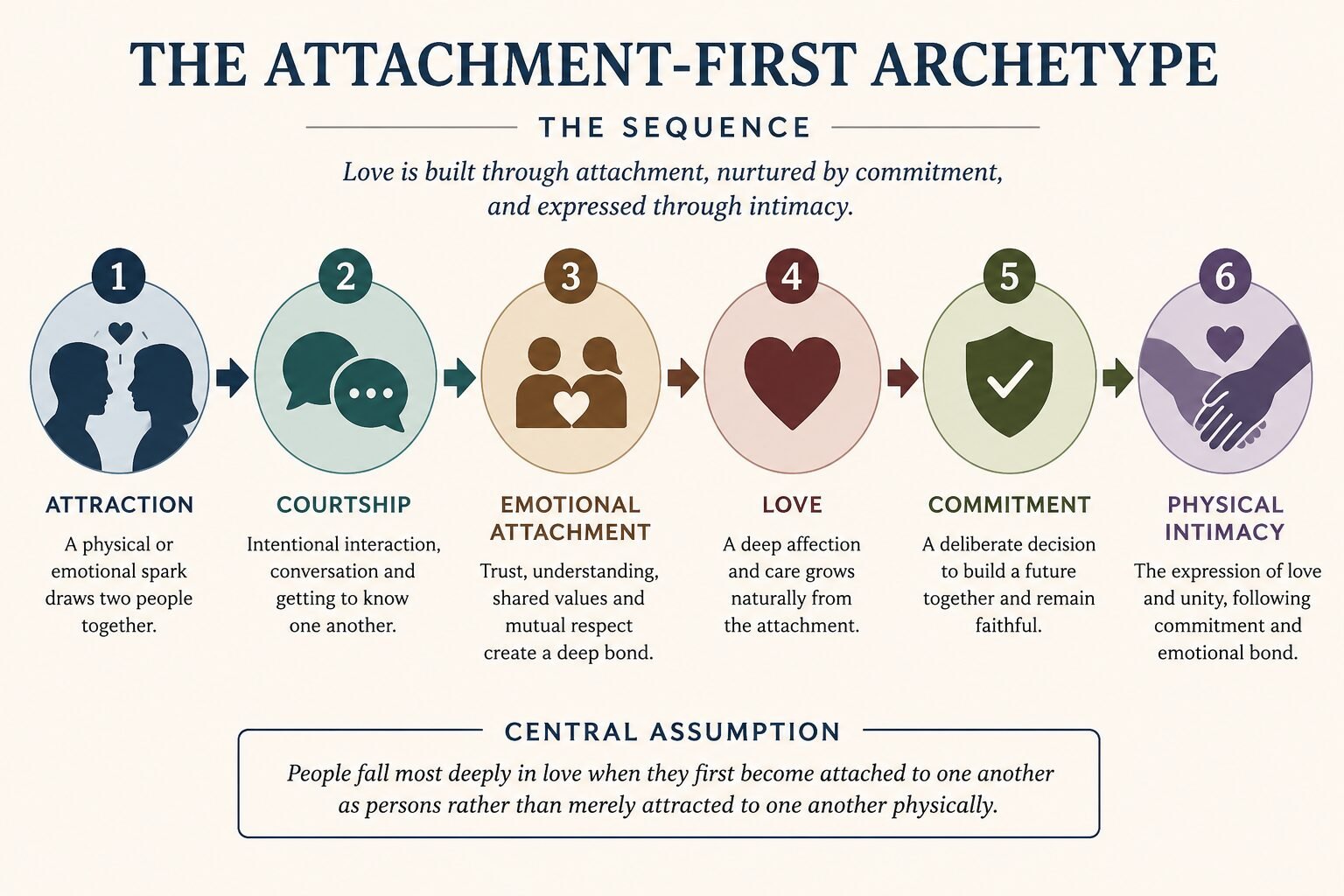
Within this model, attraction begins the relationship, but attachment sustains it. Emotional bonds develop through conversation, shared values, mutual trust and lived experience. Physical intimacy is understood not as the mechanism that creates love but as one expression of an already established relationship.
Historically, this pattern characterised many societies, although it appeared in different cultural forms. Courtship, family involvement and gradual commitment were intended to strengthen attachment before physical union.
Its central assumption is straightforward:
Love grows most naturally from emotional attachment rather than physical intimacy alone.
The Intimacy-First Archetype
The second archetype reverses much of that sequence.
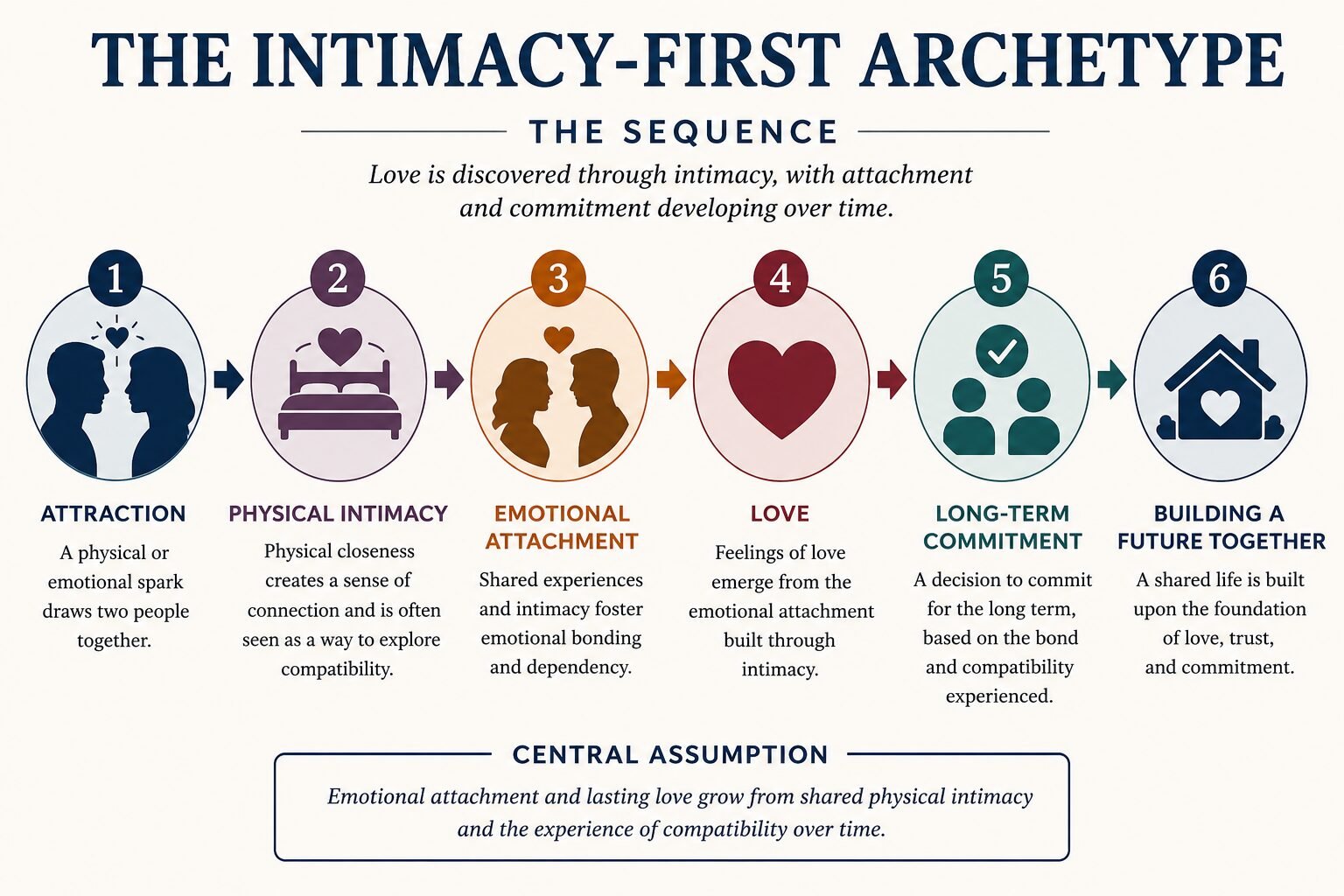
Here, physical intimacy is often viewed as a means of exploring compatibility. Emotional attachment is expected to develop through shared intimate experiences, with long-term commitment emerging only if the relationship proves successful.
This model has become increasingly common in many contemporary societies and reflects broader cultural ideas about individual autonomy, personal choice and romantic exploration.
Its central assumption is equally clear:
Attachment is created through intimacy rather than preceding it.
Reading These Archetypes Through the Holy Qur’an
Interestingly, the Holy Qur’an never explicitly discusses either of these archetypes.
Instead, it presents a broader vision of marriage and human relationships from which certain assumptions can be inferred.
Marriage is described as a relationship characterised by tranquillity (sakinah), affection (mawaddah) and mercy (rahmah) (Qur’an 30:21). These qualities are presented as defining characteristics of the marital relationship rather than as emotions that precede it.
At the same time, the Holy Qur’an consistently places physical intimacy within the institution of marriage while prohibiting zina (fornication and adultery) and even cautioning believers against approaching the circumstances that may lead to it (Qur’an 17:32).
Taken together, these themes suggest an underlying order.
The Qur’an appears less concerned with describing how romantic feelings originate than with establishing the ethical structure within which those feelings are intended to mature.
Within that structure, commitment precedes physical intimacy.
This observation does not necessarily prove that the Qur’an endorses what we have called the Attachment-First archetype. The Qur’an is not attempting to describe modern relationship psychology.
However, when the two models are placed side by side, the Attachment-First sequence appears more closely aligned with the assumptions embedded within the Qur’anic framework than the Intimacy-First model.
That conclusion is less a matter of explicit instruction than of inference from the order that the Qur’an establishes between commitment, marriage and intimacy.
Why This Matters
The distinction between these two archetypes is not simply about morality.
It is also about anthropology—about what each model assumes regarding the formation of human attachment.
Does emotional commitment generate lasting love, with intimacy strengthening an existing bond?
Or does intimacy itself generate the attachment upon which lasting love is built?
These are fundamentally different theories of human relationships.
Whether consciously or unconsciously, every society tends to organise its institutions around one assumption or the other.
An Invitation to Reflect
The purpose of comparing these archetypes is not to declare one culture superior to another.
Rather, it is to recognise that civilizations often carry implicit assumptions about human nature that deserve closer examination.
Viewed analytically, the Qur’anic framework appears to assume that stable relationships are constructed around commitment, responsibility and covenant before physical intimacy.
Whether one agrees with that framework or not, it remains a coherent and internally consistent philosophy of relationships—one that continues to shape the lives of more than a billion people around the world.
Perhaps the more interesting question is not which model modern society prefers, but which assumptions about love are embedded within the cultures we inherit, often without noticing them.