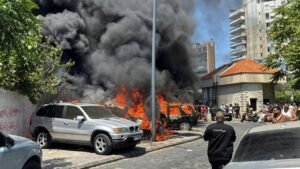
LONDON(RAHNUMA): Weeks into US-backed talks meant to trade an Israeli withdrawal for Hezbollah’s disarmament, renewed strikes and evacuation orders in southern Lebanon are raising a difficult question: Is there anything meaningful left to negotiate?
The US said on Aug. 11 that the next round of Israel-Lebanon talks would be held in Rome in early September, after officials from both sides acknowledged setbacks during meetings there earlier this month. The ministry says Israeli attacks have killed 4,346 people across Lebanon since March 2.
“The political track will reconvene in Rome in early September, and conversations will continue in Beirut, Jerusalem and Washington in the interim,” a State Department official said. “We feel good about the trajectory.”
That optimism, however, contrasts with developments on the ground.
Talks that began on Aug. 4 and were expected to last three days ended after two, as tensions escalated in southern Lebanon.
On Aug. 5 the Israeli military resumed strikes, accusing the Iran-backed Hezbollah of violating a ceasefire which was initially announced on April 17 and later extended several times. The attacks were accompanied by the first evacuation warning in weeks.
Beirut has sought a phased Israeli withdrawal from the south. But Lebanese officials are increasingly frustrated by what they see as Israeli delays ahead of October elections, while Israel maintains that Hezbollah disarmament must be verified before any further pullback.
A State Department spokesperson nevertheless described the August meetings as “constructive,” according to media reports.
But the process faces a growing test. At least 11 people were killed in Israeli strikes in southern Lebanon on Aug. 15, according to Lebanon’s Health Ministry, making them among the deadliest attacks since the country agreed to a US-mediated peace framework with Israel.
The June framework links a phased Israeli withdrawal to Hezbollah’s disarmament. But differences over sequencing and enforcement remain unresolved, and the latest escalation reportedly threatens to erode public confidence in an already politically fraught process while complicating Lebanon’s efforts to disarm the militant group.
“It was a bad deal to begin with, and now it is coming apart,” said Sami Halabi, Director of Policy at The Alternative Policy Institute (BADIL), based in Beirut. “Frankly, it is on a knife’s edge.”
Halabi said the talks’ survival may depend largely on whether Israel is prepared to make concessions.
“Much will depend on whether Israel makes any concessions, because the Lebanese side is in a very difficult position,” he told Arab News. “It put itself in that position by agreeing to a very bad deal.”
He said Lebanon’s remaining leverage was limited.
“Now, (Lebanon’s) only leverage is its presence at the negotiating table,” Halabi said. “The only leverage it has is to walk out of the room. If it does that, then the gloves are off.”
Indeed, critics of the June agreement say the framework front-loads Lebanon’s most difficult concession — disarming Hezbollah — while leaving Israel’s withdrawal conditional, gradual and without a firm deadline.
Hussein Chokr, a Beirut-based policy expert, offered a similarly bleak assessment of Lebanon’s negotiating position. He said Lebanese authorities have repeatedly framed concessions as “strong negotiating cards,” weakening the country’s hand rather than strengthening it.
“The government has not worked to acquire real sources of leverage,” Chokr told Arab News. “Instead, it has relied on the hope that the US administration will pressure Israel, even though such pressure will never, under any circumstances, be treated by Washington as a higher priority than the relationship between the US and Israel.”
For Halabi, the key question is whether President Donald Trump is willing to intervene more forcefully.
“My personal view is that he has not done anything, and Lebanon is not really his priority,” he said. “I do not think he will take significant action to stop the Israelis from doing what they are doing.”
The continued strikes are already reshaping perceptions of the talks, Halabi said.
“The talks were not going well because Israel was carrying out almost daily violations,” he said. “Now the attacks have escalated, making people believe the negotiation process is useless.
“Without negotiations, the situation returns to a logic of conflict,” he warned. “Pressure is building on all sides.”
Chokr, however, said he does not expect Israeli bombardment to derail the talks because, in his view, Lebanon’s current leadership remains committed to negotiations regardless of the military pressure.
“The party seeking negotiations is the current Lebanese authority, not Israel,” he said. “This authority has already shown that it is willing to make concessions and submit to pressure.”
Previous Israeli strikes did not change Beirut’s position or weaken its desire to continue negotiations, Chokr said: “Israel, by contrast, initially treated these negotiations as a political maneuver, a way to preempt Iran and separate the Lebanese track from the broader track between Tehran and Washington.”
But Israel’s assessment evolved, he added: “After seeing the political softness and ease with which the Lebanese authorities approached the process, Israel began to view the negotiations as an opportunity to maximize its gains.”
Those gains, he said, “may include securing the legitimacy of Lebanese recognition, or at least legitimizing its presence, without abandoning its military path of attacking Lebanon under the pretext of self-defense.
“In short, what began as an Israeli maneuver to block Iran has successfully been turned by Israel into an opportunity to gain far more than a maneuver alone could have delivered.”
The negotiations also risk becoming increasingly entangled with regional tensions. Halabi said Iran has an interest in reasserting its influence in Lebanon, whose border with Israel gives Tehran additional leverage.
“One effect of the negotiations was, in a sense, to separate regional negotiations from Lebanese negotiations,” he said. “Now, those issues are becoming linked again.”
That is particularly dangerous because wider regional diplomacy has stalled as well, he explained: “At a high level, we cannot return to the old status quo because the world is no longer the same as it was before.”
Iran-US diplomacy has stalled because both sides accuse the other of breaching a June interim agreement, and neither is currently participating in direct talks.
From Israel’s perspective, Halabi said, the country appears intent on consolidating territorial gains and could seek to create a buffer zone or pursue the annexation of southern Lebanon.
“This is becoming increasingly evident to people watching the installations Israel is putting in place, the nature of its attacks and its intransigence at the negotiating table,” he said.
He expects the process to deteriorate further before Washington intervenes. “Things will probably fall apart until the escalation gets out of hand,” he said. “Then the Americans will have to get involved again and tell the Israelis to back off.”
By then, he warned, Israel may have strengthened its position on the ground.
“In the meantime, Israel will have consolidated more territory, and we will be in an even worse position,” he said.
“I do not know whether the negotiations will survive. The president’s initiative — and it is very much the president’s initiative — is under fire. It will be very difficult to negotiate a way out of this. It could happen, but I do not think it is very likely.”
Chokr also questioned Washington’s ability or willingness to compel Israeli restraint, noting that the US has struggled to enforce Trump’s own proposals in Gaza.
“Unfortunately, Lebanon will remain trapped in this position unless its authorities work to acquire real leverage that can be used to secure actual gains in negotiations,” he said.
For ordinary Lebanese, the uncertainty carries its own cost. As negotiators debate withdrawal, disarmament and enforcement, civilians in the south remain caught between Israeli strikes, evacuation orders and a political process that has yet to deliver security.