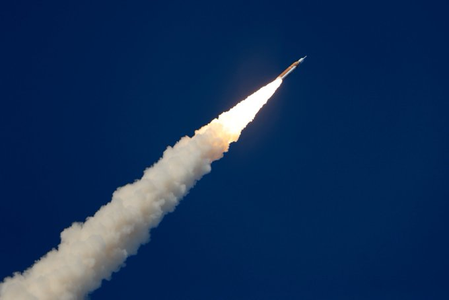
Washington, April 2 (IANS) The United States has launched its first crewed mission around the Moon in more than 50 years, with President Donald Trump and senior lawmakers hailing Artemis II as a milestone in a renewed global space race.
“Let me begin by congratulating the team at NASA and our brave astronauts on the successful launch of Artemis II; it was quite something,” Trump said at the top of his address to the nation on Iran on Wednesday night (local time), as he called the mission “amazing” and, describing the crew as “four unbelievable astronauts.”
The Space Launch System rocket lifted off from Kennedy Space Center at 6:35 p.m. (Eastern Time), sending astronauts Reid Wiseman, Victor Glover, Christina Koch and Canadian astronaut Jeremy Hansen aboard the Orion spacecraft on a 10-day journey around the Moon and back.
NASA Administrator Jared Isaacman described the launch as a turning point. “Today’s launch marks a defining moment for our nation and for all who believe in exploration,” he said. “Artemis II is the start of something bigger than any one mission.”
The mission is designed as a test flight to demonstrate life-support systems and spacecraft performance with a crew on board for the first time in the Artemis programme. It will also lay the groundwork for future missions aimed at establishing a sustained human presence on the Moon.
Orion deployed its solar arrays shortly after launch and shifted to flight operations. Engineers began checking key systems as the spacecraft entered an elliptical orbit around Earth.
NASA said the spacecraft completed both perigee and apogee burns, refining its orbit. A brief communications dropout followed one burn but was quickly resolved. The crew said they could still hear ground transmissions.
Astronauts also reported a blinking fault light during a routine system check. Ground teams are investigating the issue.
The crew is preparing for a proximity operations test. Astronauts will manually manoeuvre Orion near the rocket’s upper stage. The test is meant to validate navigation and control systems for future lunar missions.
Senate Commerce Committee Chairman Ted Cruz framed the mission in strategic terms. “Artemis II is more than a mission; it’s a message to the world that the United States will lead this era of space exploration,” he said.
He also warned of intensifying competition. “We are not the only nation with eyes on the Moon, as China is advancing its own space ambitions… we cannot afford to finish as a runner-up,” Cruz said, stressing the importance of maintaining “the high ground in space.”
Ranking Member Zoe Lofgren echoed the significance of the launch. “Congratulations to NASA and its partners on this magnificent feat,” she said, adding that the mission would “inspire people of all generations around the globe.”
NASA Associate Administrator Amit Kshatriya underscored the test nature of the mission. “Artemis II is a test flight, and the test has just begun,” he said, noting that astronauts would “put Orion through its paces so the crews who follow them can go to the Moon’s surface with confidence.”
If all systems perform as expected, Orion will execute a translunar injection burn to send the crew toward the Moon, using lunar gravity to return to Earth. The mission includes a planned flyby of the Moon’s far side before splashdown in the Pacific Ocean.