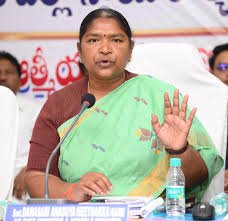
Hyderabad, April 7 (RAHNUMA): A 30-year-old Computer Science Engineering graduate, Peddhabudi Vanaja, from the hinterlands of the Telangana state, is earning around Rs 1 lakh a month.
The twist, however, is that this income does not come from an engineering job. Moving away from conventional job-seeking, she has turned entrepreneur, generating employment opportunities for others as well — truly standing up to the State government’s vision of making one crore women into billionaires.
Her journey reflects the impact of initiatives spearheaded by the Panchayat Raj and Rural Development, and Women and Child Welfare departments, under Minister Dr. Danasari Anasuya Seethakka, along with the Society for Elimination of Rural Poverty (SERP), led by Divya Devarajan.
The focus on non-conventional business avenues — such as centring units, cement brick-making, and shear wall construction — has opened new pathways for women like Vanaja. A resident of Bandapalli village in Panagal mandal of Wanaparthy district, Vanaja is among the 772 women who underwent specialised training imparted by SERP in collaboration with the National Academy of Construction.
As the State government is on a mission to construct over 3.5 lakh houses under Indiramma Housing Scheme in 2025-26 alone, there is a huge demand for construction material such as centring units, cement bricks, and shear walls. Recognising this opportunity, Minister Seethakka initiated steps to train women and encourage them to enter this sector.
The training programme aimed to build technical skills, improve safety standards, and enhance managerial capacity in construction-related activities. It covered the fundamentals of centring, its importance in ensuring quality concrete structures, and the use of materials such as timber, steel, aluminium, and modular systems, while emphasising precision and durability.
The programme also addressed the practical aspects of establishing and managing centring units, including manpower planning, material procurement, and workflow management from design to execution. Participants were trained to interpret design drawings, organise resources efficiently, and implement formwork systems in a systematic manner.
Following the training, institutional support was extended to facilitate access to credit. Vanaja secured a loan of Rs 20 lakh under the Prime Minister’s Employment Generation Programme (PMEGP), enabling her to establish her enterprise.
Recognising the growing demand for construction materials, the Minister directed officials to focus on equipping women with skills in managing centring units, cement brick manufacturing, and shear wall technologies. Acting on these directions, SERP identified interested candidates and ensured targeted training interventions.
Of the 772 trained members, 154 have already established centring units, while 16 have applied for support under PMEGP. SERP has also prepared Detailed Project Reports (DPRs) and forwarded them to districts to facilitate financial assistance through bank linkages and PMEGP support.
As on today, Vanaja provides 3 units of Centring units for the construction of Indiramma Houses in her village.
Each centring unit entails an investment of about Rs 4 lakh, a baseline benefit extended to all trained members. SERP continues to coordinate with Housing Department officials to ensure work allocation and optimal utilisation of these units. The progress is being regularly monitored by SERP’s non-farm division, with efforts underway to further encourage women’s participation in this emerging sector.