BEIRUT(RAHNUMA): As the ceasefire between Israel and Hezbollah is set to enter its second year on Friday, alarm bells are ringing louder than ever about the prospect of renewed conflict in Lebanon.
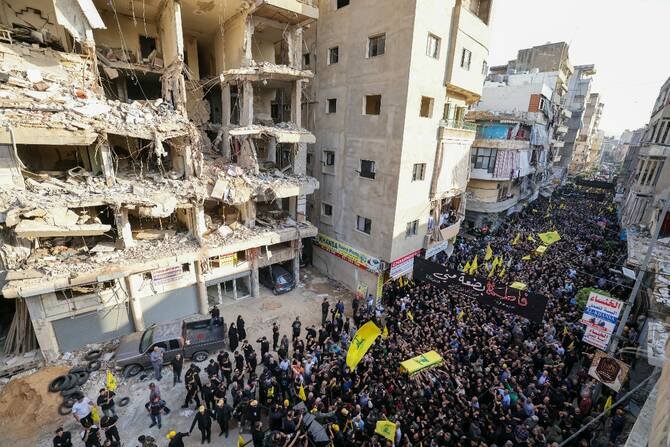
The killing last Sunday of Haytham Ali Tabatabai, Hezbollah’s military chief and its second most powerful figure after Secretary-General Naim Qassem, in a brazen attack on Beirut’s southern suburbs has shattered hopes for lasting stability.
Whether Hezbollah responds with military action or settles for a diplomatic rebuke — as some within the group have suggested — could determine whether the ceasefire survives.
The strike represents the fifth Israeli operation targeting the southern suburbs since Nov. 27, 2024, and the second to occur without advance warning.
Official records document 5,350 Israeli violations of the ceasefire over 12 months. These breaches have claimed more than 340 lives — mostly Hezbollah fighters and commanders, but also civilians, children, and women — and wounded over 650 others.
In a significant escalation, Israeli forces have for the first time struck Ain Al-Helweh, a camp housing Palestinian refugees.
The violations comprise 2,198 ground incursions, 2,983 air operations and 169 maritime breaches.
UN peacekeeping forces paint an even starker picture, reporting more than 7,500 aerial violations and roughly 2,500 ground violations north of the Blue Line since last year’s agreement, alongside the discovery and seizure of over 360 abandoned weapons caches handed to the Lebanese military.
Israel’s strategy has amounted to a slow-burn campaign against Hezbollah, systematically degrading its capabilities while the Lebanese Army races to disarm the group south of the Litani River.
The army claims to have completed over 80 percent of this mandate, with a year-end deadline looming before operations extend northward — a territory where Hezbollah has flatly refused to surrender its arsenal, insisting Lebanese political leaders resolve the matter independently.
The conflict itself dealt Hezbollah serious blows, with decimated leadership ranks and catastrophic losses to its weapons stockpiles. But perhaps most troubling is Israel’s physical encroachment on Lebanese soil.
UN monitors have documented concrete T-shaped walls constructed by the Israeli military near the Blue Line, with surveys confirming that these barriers extend into Lebanese territory southwest of Yaroun, effectively sealing off more than 4,000 square meters of Lebanese land from its own citizens. Similar constructions have appeared southeast of the same town in recent weeks.
More broadly, Israeli forces maintain control of five positions scattered across 135 kilometers of Lebanese territory—from Shebaa Farms to Ras Al-Naqoura —just 500-1,000 meters beyond the Blue Line.
The United Nations has demanded swift, impartial investigations into Israeli military operations, particularly the strike on the Palestinian refugee camp, citing potential violations of international humanitarian law and calling for accountability.
Twenty Lebanese nationals languish in Israeli prisons, mostly in Ofer, including 10 Hezbollah operatives detained during earlier fighting around Aita Al-Shaab, a naval officer captured in a commando raid, and nine civilians. Their families have heard nothing official from the International Committee of the Red Cross about their conditions or well-being.
An official Lebanese source considered that “releasing the detainees is part of the terms of the ceasefire agreement, along with the withdrawal from the occupied territories, and Lebanon does not hold any Israeli detainees to negotiate on this issue.”
Israel’s scorched earth policy in the frontline border villages continued, as it carried out attacks on any attempt to rebuild. The World Bank estimates the cost of reconstruction at around $11 billion.
“Between 10 and 15 villages have been completely wiped off the map,” said Tarek Mazraani, an engineer from the border town of Houla and the coordinator of the “Southern Border Towns’ Gathering.”
Mazraani estimates that between 65,000 and 70,000 people remain displaced from their homes and wiped off villages.
“Those who have returned to their homes are those who are completely unable to move anywhere else, mostly elderly living amid the rubble of their homes, exposed daily to the horrors of shelling and curfews, with no hospital to treat them,” he told Arab News.
Anyone who wants to bury their dead must obtain permission from UNIFIL, which in turn informs Israel to allow the burial.
“Despite this, the Israeli army bombs the vicinity of the funeral procession every time,” Mazraani said.
He added that those displaced from their villages rented houses in Nabatieh, Tyre, Sidon, Iqlim Al-Kharroub, the southern suburb of Beirut and Mount Lebanon. Most are farmers and peasants, but among them are teachers, engineers, freelancers and members of the official security forces.
“Since the war ended, these people have been left without any official or partisan support. One of the region’s wealthy residents, who lost everything in the war, now works as a delivery man,” Mazraani said.
Those who are displaced are caught between the shadow state of Hezbollah and the Lebanese state: “Everyone is exploiting their tragedy, even within our own southern community. House rents are extremely high, and we never feel at home.”
One, who chose to remain anonymous, said: “People who are not affiliated with any party are far removed from politics. Our concern is securing our livelihood and ensuring financial coverage if we need hospitalization. We feel we have been orphaned and abandoned, especially when we resorted to a Hezbollah institution and were told that they had no money.”
He added: “The people of the destroyed areas are paying the price. Some resent Hezbollah for the war it waged and the thousands of deaths it caused, while others fear that the other side will gloat over us and offer no reassurance.”
Lebanese expectations regarding Israeli threats to resume the war — undermining the ceasefire agreement brokered by France and the US and whose terms closely resemble the main points of Resolution 1701 — are contradictory.
Some political observers in Lebanon view the threats as “exaggerated,” while others believe “a strike is inevitable but will not escalate into an all-out war; they aim to push Lebanon into negotiations.”
Earlier this month, Lebanese President Joseph Aoun said: “Lebanon has no choice but to negotiate, and the language of negotiation is more important than the language of war.”
Prime Minister Nawaf Salam affirmed this, expressing hope for “US support for a diplomatic solution.”
For now, however, direct negotiations between Lebanon and Israel remain entirely off the table.