Washington, March 12 (IANS) Senior Pentagon commanders told senators on Thursday that the United States is sustaining a large and complex military effort stretching from Europe to the Middle East, relying heavily on allied support, commercial transport networks and ageing but capable mobility fleets.
Testifying before the Senate Armed Services Committee, Gen. Alexus Grynkewich of US European Command and Gen. Randall Reed of US Transportation Command described how the U.S. military is moving forces, equipment and supplies across continents while supporting ongoing operations linked to Iran and maintaining deterrence in Europe.
Grynkewich said the current campaign, Operation Epic Fury, requires an extraordinary level of coordination across air, naval and allied forces.
“It is incredibly complex,” he said. “The sequence of events and the technical acumen that is required at the operational and tactical level is quite high.”
The general said European allies have played a critical logistical role in enabling US military operations.
“They have provided access, basing and overflight that enable General Reed’s operations to refuel aircraft coming from the United States or support the large volume of logistics that flow through Europe,” Grynkewich told lawmakers.
He said U.S. bases and alliances in Europe remain central to American power projection beyond the continent.
“One of the missions of U.S. European Command is to serve as a power projection platform,” he said, adding that having capabilities in Europe makes it “much easier to project power with our network of bases and allies.”
Reed, whose command manages global military logistics and transportation, said the U.S. mobility system had performed strongly under wartime pressure.
“The tanker fleet has been very impressive in getting forces across the ocean and into U.S. Central Command (CENTCOM),” Reed said.
However, he acknowledged that the United States relies heavily on commercial transportation networks to sustain military operations worldwide.
“Day to day, in competition, about 40 per cent of what we fly around the skies is commercial,” Reed said.
He added that commercial shipping plays an even larger role in sustaining military forces once operations begin.
“In the case of sealift, once the Ready Reserve Force makes the initial surge, commercial shipping takes over for sustainment, and more than 90 per cent of all sustainment is done by the commercial fleet,” Reed said.
The hearing highlighted lawmakers’ concerns that commercial carriers and infrastructure could be vulnerable to cyberattacks during a major conflict.
Reed said the Pentagon works closely with private companies to strengthen cyber defences and monitor vulnerabilities.
“We red-team and cooperate with them, and provide support for cyber hygiene,” he said.
Grynkewich also warned that Russia continues to conduct ‘hybrid activities’ across parts of Eastern Europe, including sabotage and information operations.
“We see a fairly robust amount of what we call Russian hybrid or asymmetric activities,” he said, referring to incidents reported in the Baltic states and Poland.
At the same time, he noted that most Russian ground forces remain focused on the war in Ukraine.
“As far as conventional troop buildups are concerned, most of the Russian ground forces are focused on Ukraine,” Grynkewich said.
The testimony also underscored the growing importance of logistics and mobility systems in modern warfare, particularly as the United States prepares for potential conflicts with major powers.
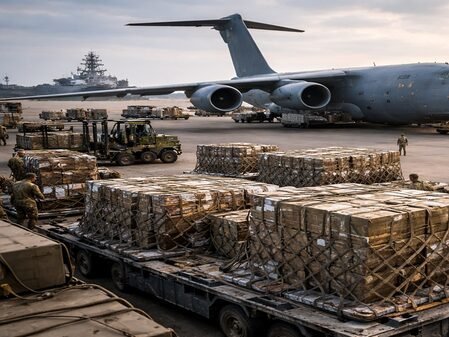
Reed said strategic airlift aircraft such as the C-17 and C-5 remain essential for moving American forces overseas because most U.S. troops are based domestically.
“More than 85 per cent of the joint force still resides here,” Reed said, referring to the United States. “When they are needed abroad, those are the aircraft we use to start that move.”