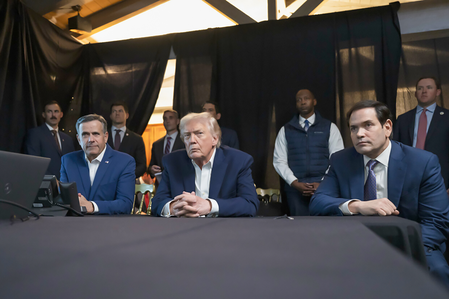
Washington, Jan 29 (IANS) A contentious US Senate hearing on Venezuela this week offered a revealing look at how Washington is fusing energy control, China’s debt diplomacy, sanctions, and calibrated force — a strategic mix that resembles challenges India faces across the Global South and the Indo-Pacific.
Testifying before the Senate Foreign Relations Committee, US Secretary of State Marco Rubio showcased Venezuela as a case study of how great-power competition now plays out through oil access, political transition, and strategic-level signaling, rather than through traditional military confrontation alone.
“We had in our hemisphere a regime operated by an indicted narcotrafficker that became a base of operation for virtually every competitor, adversary, and enemy in the world,” Rubio said, describing the Maduro-era government as a hub for China, Russia, and Iran.
Rubio said China, in particular, had leveraged Venezuela’s oil to deepen its foothold in the Western Hemisphere. “China was receiving oil at about $20 a barrel discount, and they weren’t even paying money for it,” he said. “It was being used to pay down debt that they were owed.”
“This is the oil of the people of Venezuela, and it was being given to the Chinese as barter,” Rubio added.
Rubio’s description will strike a chord in New Delhi, where officials have for years flagged China’s use of cheap energy, debt and non-transparent deals as tools to build influence — often at the cost of market fairness and sovereign decision-making.
Rubio described the situation as “an enormous strategic risk for the United States not halfway around the world, not in another continent, but in the hemisphere in which we all live,” adding that it was “untenable” and “had to be addressed.”
At the core of Washington’s current approach is tight control over Venezuelan oil flows — an issue of direct relevance to India, one of the world’s largest energy importers and a country that has navigated US sanctions regimes on Iran and Russia to safeguard its fuel security.
Rubio emphasised that the United States has imposed a “quarantine, not a blockade,” allowing sanctioned Venezuelan oil to reach markets only under strict conditions.
“We will allow you to move it to market at market prices, not at the discount China was getting,” he said. “The funds from that will be deposited into an account that we will have oversight over, and you will spend that money for the benefit of the Venezuelan people.”
He said the immediate objective was to avert economic collapse. “They were producing oil, they were drilling, but they had nowhere to put it,” Rubio said, adding that Venezuela faced a “fiscal crunch” and urgently needed funds “to pay the police officer, the sanitation workers, the daily operations of government.”
Rubio stressed that the arrangement is temporary. “This is not going to be the permanent mechanism,” he said. “This is a short-term mechanism.”
For India, the episode illustrates how oil access is increasingly governed by geopolitics rather than market forces alone — a trend New Delhi has flagged in international forums as sanctions, export controls and strategic chokepoints reshape global energy flows.
Rubio said Venezuela has already begun shifting away from reliance on adversaries. “They used to get 100 percent of their diluent from Russia,” he said. “They are now getting 100 percent of that from the United States.”
Beyond energy, Rubio framed the Venezuela operation as a broader signal to China — a theme closely watched in New Delhi amid intensifying US-China competition in the Indo-Pacific.
Asked whether the operation could influence Beijing’s calculations on Taiwan, Rubio said, “The situation on Taiwan is a Xi legacy project,” but added that US actions were “certainly startling to China, to Russia, to Iran, to any adversary around the world because the US is the only country in the world that could have done this operation.”
For Indian analysts watching US-China tensions over Taiwan and the South China Sea, the comments point to a broader US message — that American power will be felt wherever its interests are involved.
Rubio also outlined a three-phase US plan for Venezuela — stabilization, recovery and transition — reflecting an approach that focuses on order over rapid political change.
“The end state here is we want to reach a phase of transition where we are left with a friendly, stable, prosperous Venezuela, and democratic, in which all elements of society are represented in free and fair elections,” he said.
But he cautioned against expectations of quick results. “We’re not going to get there in three weeks,” Rubio said. “It’s going to take some time.”
He said stability was the first priority after the removal of Nicolas Maduro. “The concern was what happens in Venezuela? Is there civil war? Do the different factions start going at each other?” he said, adding that “all of that has been avoided.”
Rubio acknowledged the risks of working with imperfect interim authorities. “We are dealing with individuals that have been involved in things that in our system would not be acceptable,” he said. “But you have to work with the people that are in charge of the elements of government.”
India, which has continually emphasised sovereignty, gradual reform and stability over externally imposed regime change, has often taken a similar view in conflict-prone regions.
Rubio said early signs of reform were visible, citing changes to investment rules. “They have passed a new hydrocarbon law that basically eradicates many of the Chavez era restrictions on private investment,” he said. “It probably doesn’t go far enough, but it’s a big step from where they were three weeks ago.”
He also pointed to the release of detainees. “By some estimates up to 2,000,” Rubio said, though he noted they were being released “probably slower than I would like.”
On the use of force, Rubio sought to reassure lawmakers. “We are not postured to nor do we intend or expect to have to take any military action in Venezuela at any time,” he said.
“The only military presence you will see in Venezuela is our marine guards at an embassy,” he added, while stressing that the US President retains authority to respond to “an imminent threat.”
For India, the Venezuela debate brings several familiar issues together. It shows how energy is now used for leverage, how China expands its influence through debt and long-term deals, and how sanctions and military power are increasingly used as signals rather than as steps toward war. Washington’s handling of Venezuela can be seen less as a Latin American story and more as an early indication of how competition among major powers is likely to play out.