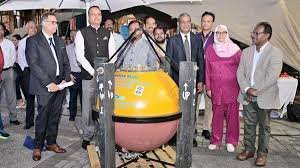
Hyderabad, Jan.24 (RAHNUMA): The Indian National Centre for Ocean Information Services (INCOIS), under the Ministry of Earth Sciences (MoES), has set a global example in coastal monitoring through its Wave Monitoring Along Nearshore (WAMAN) buoy network – an innovative system built on community participation and trust.
Launched to address the long-standing gap in nearshore wave observations, WAMAN has transformed operational wave forecasting along India’s coastline by combining advanced technology with local ownership. Since 2007, the network has sustained 17 real-time wave buoys across the coasts of India, Seychelles and Mauritius, delivering continuous data for wave forecasting and early warnings on high waves and swell events.
Unlike conventional top-down monitoring systems, WAMAN actively involves coastal communities – particularly fishers and harbour stakeholders – as partners in safeguarding and reporting buoy status. This approach has significantly reduced equipment loss and data gaps, ensuring long-term reliability of observations.
“Nearshore observations cannot survive without community trust”, said Dr. T. M. Balakrishnan Nair, Director of INCOIS and architect of the WAMAN programme. “Once people understood that wave information helps them decide when it is safe to go to sea, the buoys became a shared responsibility.”
Beyond operational services, WAMAN has emerged as a key scientific resource for the Indian Ocean region. The long-term dataset supports wave-model improvements, satellite validation, and climate studies assessing changes in coastal wave patterns.
The success of the initiative has drawn international attention, with INCOIS extending the WAMAN model through collaborations with Indian Ocean rim countries and global organisations such as RIMES, the Indian Ocean Rim Association, and the Global Ocean Observing System (GOOS). The model also aligns with global disaster preparedness efforts, including the UN’s “Early Warnings for All (EW4ALL)” initiative.
“Many countries can deploy buoys, but sustaining them is the real challenge”, Dr. Nair noted. “WAMAN proves that aligning observations with user needs and local ownership ensures sustainability.”
As nations seek resilient and cost-effective coastal monitoring solutions, WAMAN stands out as a reminder that community-driven science can deliver both societal impact and global relevance.