1st ODI: Brar, Dubey, Gill star as India beat Afghanistan by seven wickets, take 1-0 lead

© Provided by The Rahnuma Daily

1st ODI: Brar, Dubey, Gill star as India beat Afghanistan by seven wickets, take 1-0 lead

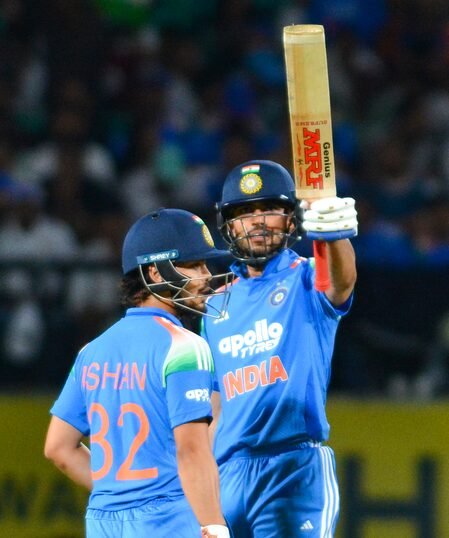
Dharamshala, June 13 (IANS) The crowd at the HPCA Stadium may have come expecting a full 50‑over contest, but they were treated to an entertaining 25‑over chase in a match truncated due to rain as skipper Shubman Gill hit 84 not out to help India beat Afghanistan by seven wickets in the ODI series opener on Saturday.

After debutants Gurnoor Brar and Harsh Dubey claimed three wickets apiece to help India bowl out Afghanistan for 194, despite a blistering 102 coming from Rahmanullah Gurbaz’s willow, Gill produced a knock of absolute authority and was at his sublime best to hit 11 fours and two sixes in his 66-ball knock, taking India home with 13 balls to spare.

India needed a solid start, and skipper Rohit Sharma provided it before a mix‑up cut short his innings. Shubman Gill carried on fluently, striking boundaries to keep the tempo high. He was joined by Ishan Kishan, who sparkled on his return to ODIs with a 22‑ball 34, while peppering the field with aggressive strokes.

KL Rahul then took charge in the middle overs, ensuring there was no let‑up. The right‑hander remained unbeaten on a 19‑ball 39, laced with four boundaries and three sixes to guide India home with ease, as they never looked under pressure in the chase.

Afghanistan’s bowlers struggled to find rhythm. Rashid Khan was expensive but managed to pick up a wicket, while the pacers leaked runs throughout. The visitors failed to build momentum with the ball, allowing India’s batters to dominate from start to finish, as the hosts maintained their unbeaten record against them.

The innings began dramatically when Azmatullah Omarzai conceded five wides and a no‑ball, before Rohit was struck on the wrist by his short delivery, and required treatment from the physio. Rohit soon found his rhythm, punching through covers and pulling Omarzai for a six to reach 16,000 international runs. Gill joined in with crisp drives, and the pair had a 46-run opening stand.

The opening stand was broken when a mix‑up led to Rohit’s run‑out for 16. Gill carried on, unfazed, and was joined by Ishan Kishan, whose aggressive knock included three fours and a six, but Rashid Khan’s googly castled him in the 13th over.

Shreyas Iyer added a few boundaries, but pulled to mid-on for 12 off Zia. At 137/3, India still held control thanks to Gill’s composure. The skipper reached his fifty off 37 balls with a pull off Nabi and crossed 3,000 ODI runs during the chase.

He struck sixes and fours with absolute authority, while Rahul ensured there were no late hiccups. He began cautiously but soon accelerated with his lofted cover drives and pulls, before completing the chase in the 23rd over and helping India take a 1-0 lead in the three-match series.

Previously, Gurbaz had luck on his side – India didn’t review an lbw appeal when he was on 14, and he made them pay. After taking time to get going and understanding the pitch, he launched into the Indian back-up bowlers with some outrageous clean hitting in a 25-overs-a-side contest.

In an outstanding knock studded with eight fours and as many sixes, Gurbaz brought up his ninth hundred off 48 balls, the fastest by an Afghan batter in the 50-over format and the second fastest by any batter against India in ODIs.

At one point, Afghanistan looked set to get beyond 220, but Gurbaz’s dismissal helped India claw back. Barring Hashmatullah Shahidi and Azmatullah Omarzai making 20s, none of the other batters got past single digits. For India, Gurnoor and Harsh maintained their composure and bowling smarts to pick three-fors while Arshdeep Singh and Nitish Kumar Reddy chipped in with two scalps each.

Afghanistan’s innings began shakily as Ibrahim Zadran, Sediqullah Atal, and Rahmat Shah fell inside the powerplay. Gurbaz, however, counter‑attacked spectacularly as Washington Sundar, Dubey, and Prasidh Krishna bore the brunt of his big-hitting. With 78 percent of his runs coming in boundaries, Gurbaz put on a treat for fans who braved four hours and 15 minutes of rain delay and left them enthralled.

Shahidi offered support with a fluent 27, while adding a 116-run stand with Gurbaz at a run‑rate of over ten. Azmatullah Omarzai chipped in with a brisk 26, but once Nitish Kumar Reddy dismissed Gurbaz with a pinpoint slower yorker for 102, Afghanistan’s momentum stalled.

Left-arm spinner Dubey recovered from an expensive start to strike thrice – removing Shahidi, Omarzai, and AM Ghazanfar to take 3-47, while lanky right-arm pacer Brar capped his debut by castling Rashid Khan with pace and later had Zia Ur Rahman Sharifi caught at long‑on to finish with 3-27, as India’s bowlers, rattled initially, pulled things back smartly in the final overs.

Brief scores:

Afghanistan 194 all out in 24.5 overs (Rahmanullah Gurbaz 102, Hashmatullah Shahidi 27; Gurnoor Brar 3-27, Harsh Dubey 3-47) lost to India 195/3 in 22.5 overs (Shubman Gill 84 not out, KL Rahul 39 not out; Rashid Khan 1-37, Zia Ur Rahman Sharifi 1-39) by seven wickets

share it
Facebook
Twitter
LinkedIn
WhatsApp

Leave a Reply

Your email address will not be published. Required fields are marked *


Latest Post

More pacts than results: Pakistan’s expanding defence partnerships under scrutiny Jerusalem, Oct 31 (IANS) Pakistan’s efforts to establish a central role in an emerging network of defence partnerships among Muslim-majority nations, stretching from the Mediterranean to Southeast Asia, have brought its strategic ambitions under scrutiny, a report has stated. It noted that Islamabad faces questions over how it will accommodate competing ideological influences, navigate the conflicting interests of Saudi Arabia and Qatar, and sustain its expanding commitments with limited economic, industrial and military resources. “Pakistan has discovered a new enthusiasm for defence alliances. On October 21, Islamabad joined Turkey, Qatar and Indonesia in signing the Badr Memorandum of Understanding in Doha, an agreement intended to strengthen military production, technological cooperation, training and defence industrial capabilities. The announcement follows the Mecca Joint Defence Agreement signed in August between Pakistan, Saudi Arabia and Turkey, which established a considerably more ambitious framework for mutual military assistance,” Sergio Restelli, an Italian political advisor, author and geopolitical expert, wrote in ‘The Times of Israel’. According to Restelli, the primary concern is not that defence ties inevitably lead to ideological alignment, but that an expanding web of military partnerships could open the door to political influence, institutional infiltration and the gradual legitimisation of actors whose agendas may undermine regional stability. “The distinction between legitimate defence industrial cooperation and political alignment must therefore remain central to any assessment of the Badr agreement,” he stated. Highlighting the more immediate nature of the challenge, Restelli noted that Pakistan is seeking to strengthen its defence ties with Qatar while positioning itself as a key pillar of the Saudi-led security framework established under the Mecca agreement. “Saudi Arabia and Qatar have a long history of strategic rivalry. The 2017 Gulf crisis, when Riyadh and its allies imposed a blockade on Doha, exposed profound disagreements over political Islam, relations with Iran and the regional role of the Muslim Brotherhood. Although the Al-Ula reconciliation of 2021 restored diplomatic relations, it did not eliminate the underlying differences in their foreign policy outlooks,” the expert mentioned. “For Pakistan, this creates an obvious contradiction. The Mecca agreement is intended to establish a credible framework of collective deterrence. Its provisions contemplate military assistance in the event of an attack on a member, although the nature and extent of that assistance remain subject to national decisions. Yet Islamabad is simultaneously strengthening another defence arrangement with Qatar, whose strategic calculations have not always coincided with those of Riyadh,” he added. Pakistan is seeking to position itself at the crossroads of all these interests while portraying the resulting network of partnerships as evidence of its growing strategic importance. However, alliances are not accomplishments in themselves; their significance depends on the security they provide, the threats they deter and the capabilities they help develop, Restelli argued. “For now, Islamabad has considerably more agreements to display than results to demonstrate. And in its eagerness to appear indispensable to everyone, Pakistan may be stretching itself too thin to be genuinely indispensable to anyone,” he noted. –IANS scor/as
All-Han Chinese politburo exposes deepening ethnic exclusion under Xi Jinping: Report Naypyidaw, Oct 31 (IANS) Under China’s ethnic autonomy law, the head-of-government post in autonomous regions is reserved for a member of the local ethnic minority, but the more powerful party secretary position has generally been occupied by a Han Chinese official, a report has stated. It noted that for decades, minorities have accounted for roughly 10 to 11 per cent of full and alternate Central Committee members, yet the majority have remained in the alternate tier. “No ethnic minority official has ever joined the Politburo Standing Committee. A handful reached the wider Politburo: Zhuang General Wei Guoqing and Mongolian leader Ulanhu served there during the Mao and early reform years; Hui Liangyu later served in the body and became a Vice Premier. Those cases show the barrier isn’t formal, but they also highlight how rarely it has been crossed,” a report in Myanmar’s media outlet ‘The Irrawaddy’ detailed. According to the report, ethnic policy under Chinese President Xi Jinping has increasingly focused on “forging a strong sense of community for the Chinese nation.” At the 2021 Central Ethnic Work Conference, it said, Xi tied the standards for officials to their firm backing of centralised party leadership and commitment to his national community agenda. The report noted that the approach prioritises political cohesion, a shared national identity and security over representation of distinct ethnic groups. “Perhaps this policy did not directly cause the all-Han Politburo. Public records don’t reveal the bargaining, vetting or rejected candidates behind elite appointments. Still, the roster fits a system where minority identity can warrant representation in congresses and autonomous governments but offers little access to the center,” it mentioned. The report highlighted that China’s Communist Party appointed its 24-member Politburo in October 2022, with every member being a Han Chinese man. For the first time in 25 years, it said, the body had no women, while none of China’s 55 officially recognised ethnic minority groups secured a place. Four years later, the group has become even more exclusive. “In October 2025, the party expelled Central Military Commission Vice Chairman He Weidong. Former Xinjiang Party Secretary Ma Xingrui followed in July 2026, and top general Zhang Youxia last month. Official notices accused all three of serious violations; the notice on Zhang also alleged disloyalty, ‘faction-building’ and a remarkably large number of bribes,” the report detailed. “Their removal leaves an active Politburo of 21—a concentration that tells us something important about power under Xi Jinping. Diversity exists farther down the political system, often through quotas and administrative rules. It disappears where the most consequential decisions are made,” it added. –IANS scor/as
Govt reviews watershed projects in Pune, urges upkeep of water structures New Delhi, Oct 31 (IANS) Department of Land Resources (DoLR) Secretary Dilip Kumar reviewed watershed development works under the Watershed Development Component of the Pradhan Mantri Krishi Sinchayee Yojana 2.0 (WDC-PMKSY 2.0) in villages of Maharashtra’s Pune district, an official statement said on Saturday. Kumar urged villagers to take collective responsibility for regular maintenance and repair of the water harvesting structures created under Watershed Development Scheme, to keep these assets functional for the next 20 years. He also called for sustained efforts to transform villages under the Khed Project into water-secure and self-reliant communities, on the lines of Hiware Bazar. The review was done in Varude, Gulani and Wafgaon villages of Pune district, on October 30, 2026. Villagers said that watershed development works across 11 villages under the Khed Project had improved groundwater levels, enabling farmers to cultivate two to three crops annually thereby increasing agricultural income and rural livelihoods. Despite the drought-like conditions this year, water stored in farm ponds and improved water levels in wells associated with cement nala bunds and CCT structures have helped irrigate standing crops, according to villagers. The key objectives of watershed development under the scheme include soil and water conservation measures, enhancing agricultural productivity, and promoting sustainable rural development. “Water is the foundation of our future. Every drop of rain must be conserved to make villages water-secure and self-reliant,” Kumar told villagers. The government official visited watershed structures developed using the ridge-to-valley approach, including Continuous Contour Trenches (CCT), earthen nala bunds, cement nala bunds, Kolhapuri-type weirs and ponds for water storage. He reviewed the effectiveness of these structures in reducing rainwater runoff, enhancing groundwater recharge and improving water availability for agriculture, changes in groundwater levels and benefits received by beneficiaries. The government also reviewed farm ponds, horticulture plantations and agricultural equipment provided to beneficiaries under the scheme, along with benefits extended to women’s self-help groups.
Couple, 5-month-old son killed as pickup truck hits motorcycle in MP’s Shajapur Shajapur (Madhya Pradesh), Oct 31 (IANS) Three members of a family, including a five-month-old child, were killed when a speeding pickup truck collided with their motorcycle in Madhya Pradesh’s Shajapur district, police said on Saturday. The deceased have been identified as Ajit Panwar, his wife Pooja Panwar and their five-month-old son Shivanshu. They were residents of Indra Colony in Ashta town of neighbouring Sehore district. The accident occurred in the Salaslai police station area when the family was travelling from Bolai village towards Ayyapur for temple darshan. According to preliminary investigation, a stray dog suddenly came in front of their motorcycle. Ajit, who was riding the two-wheeler, tried to avoid hitting the animal but lost control of the motorcycle, which swerved into the path of a pickup truck approaching from the opposite direction. The pickup truck hit the motorcycle with considerable force, leaving all three family members critically injured. The motorcycle was badly damaged in the collision. The injured were rushed to a nearby hospital, where doctors declared all three dead. The family had left home on Saturday to visit a temple and offer prayers to mark the completion of five months of their son Shivanshu. However, they met with the fatal accident before reaching their destination. “The family was going for temple darshan with their child when a stray dog suddenly came in front of their motorcycle. The rider tried to save the animal but lost control and collided with a pickup coming from the opposite direction,” a police official said. The pickup driver fled the scene after the accident. Police seized both vehicles and registered a case against the unidentified driver for rash and negligent driving. “Efforts are underway to trace the absconding driver with the help of CCTV footage and eyewitness accounts. The bodies have been sent for post-mortem examination, and further investigation is underway,” the official added.
Karnataka using KMF price hikes to cover financial mismanagement, alleges Pralhad Joshi New Delhi, Oct 31 (IANS) Union Minister for Consumer Affairs, Food and Public Distribution Pralhad Joshi on Saturday criticised the Congress government in Karnataka over the hike in Nandini curd prices, alleging that the state was using the Karnataka Milk Federation (KMF) as a tool to offset the financial strain caused by what he termed fiscal mismanagement. In a statement, Joshi said the Congress government has created a new record in price hikes by imposing unprecedented increases on essential commodities, thereby putting an additional burden on ordinary people. He alleged that the government led by Chief Minister D.K. Shivakumar was using KMF to cover up its financial mismanagement and depleted state coffers by resorting to excessive price hikes. According to Joshi, the price of 500 ml Nandini curd has been increased from Rs 28 to Rs 34, a hike of Rs 6 or 21.43 per cent. Similarly, the price of one litre of curd has been raised from Rs 54 to Rs 68, an increase of Rs 14 or 25.93 per cent. “While giving curd to the people, the Congress government is enjoying the butter,” he remarked, accusing the government of exploiting consumers. Pointing out that the government increased the price of milk by Rs 8 per litre just a day earlier, Joshi said the latest increase in curd prices, ranging from 21 to 26 per cent, would severely affect poor and middle-class families. He further alleged that the Congress government, which had made development a distant dream in Karnataka, was now collecting money from the poorest sections of society through repeated price increases in KMF products. The Union Minister said the successive hikes reflected the government’s anti-people policies and its failure to manage the state’s finances effectively. The Karnataka government has announced an Rs 8 per litre hike in the price of Nandini milk, which takes effect on November 1, 2026. The government states that out of the Rs 8 increase, Rs 7 goes directly to dairy farmers and Rs 1 goes to the milk cooperatives (KMF) for operational expenses. –IANS mka/skp
Tamil Nadu raises DA from 60 pc to 63 pc, effective July 1 Chennai, Oct 31 (IANS) Tamil Nadu Chief Minister C. Joseph Vijay has ordered a three-percentage-point increase in dearness allowance for government employees and teachers, with pensioners and family pensioners also benefiting from the revision announced ahead of Deepavali. The increase, which raises the allowance from 60 per cent to 63 per cent, will take retrospective effect from July 1, 2026. Approximately 16 lakh employees, teachers, pensioners and family pensioners will benefit, according to a notification issued by the state government. The measure will impose an additional annual expenditure of Rs 1,858 crore on the state exchequer. The government said it would allocate the additional funds required to implement the revision as part of its commitment to the welfare of serving and retired personnel. The decision follows the Union government’s increase in dearness allowance for central government employees from 60 per cent to 63 per cent, effective July 1. Tamil Nadu has adopted the same revised rate and commencement date for its employees and teachers. In its notification, the government highlighted the contribution of government officials and teachers to the formulation and implementation of welfare schemes. It said their work played an important role in ensuring that programmes designed for public welfare were implemented effectively. The administration was introducing and carrying out various initiatives for the benefit of the people, the notification said. Government employees and teachers were key participants in this process, contributing both to the planning of programmes and their delivery. Recognising these responsibilities and giving priority to employee welfare, the Chief Minister considered the revision following the Centre’s announcement and ordered the corresponding increase for the state workforce, the government said. The notification also emphasised the inclusion of pensioners and family pensioners among the beneficiaries. The financial commitment, it said, reflected the government’s concern for all four groups covered by the announcement. With Deepavali approaching, the government said the increase would help beneficiaries celebrate the festival with greater happiness. The announcement places the welfare of employees, teachers and pension-dependent households at the centre of the festive-season measure. Although the revised allowance takes effect retrospectively from July, the notification provided in the announcement does not specify when arrears will be paid. It confirms the effective date, the revised rate, the estimated number of beneficiaries and the recurring annual expenditure the state will bear under the decision. –IANS aal/uk

Get free tips and resources right in your inbox, along with 10,000+ others

Related Article