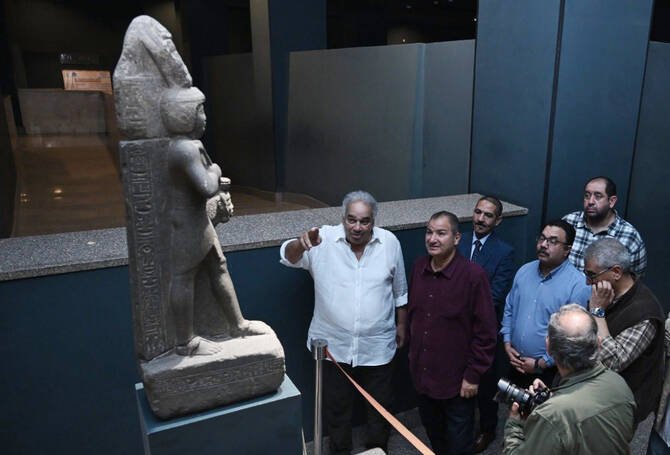
LUXOR(RAHNUMA): Egypt’s Ministry of Tourism and Antiquities has completed work on Cache Hall at Luxor Museum in preparation for its reopening.
Tourism and Antiquities Minister Sherif Fathy said that the project supported the strategy to modernize museums and enhance the cultural experience for visitors.
Prof. Mahmoud Mabrouk, a member of the museum’s Display Scenario Committee, said that the number of displayed artifacts had increased from 17 to 26 following recent additions.
The redistribution and development process took four months to complete. During this time, the cobra statue was worked on and several other artifacts restored.
The hall now features modern displays, information panels, specialized lighting, and interactive screens to better engage the public.
Significant ancient Egyptian artifacts include a statue of Tutankhamun in the artistic style of Akhenaten’s reign, and a sculpture that depicts the symbolic fusion of human and lion forms, representing kingship.
Among the most important pieces is a statue of Amenhotep III, regarded as one of the last documented sculptures of the pharaoh.
The collection also includes a black granite statue of Horemheb, along with distinctive statues of the deity Hathor.
Renovations include installing new marble floors and skirting boards, an arched gypsum-board ceiling, and converting part of the staircase into a ramp for improved accessibility.
Wooden paneling has been replaced with natural stone partitions, and two new display cases added at the entrance.
The Luxor Cache was originally discovered in 1989 during soil testing in the courtyard of Luxor Temple.
A deep pit was found beneath the ground containing royal and divine statues dating from the 18th to the 25th Dynasties, about 1550 to 656 B.C.
The cache was uncovered by an Egyptian mission working under the direction of Dr. Mohammed El-Saghir.
Mustafa El-Saghir, professor and archaeologist, explained that the work began when a worker found a stone fragment in sandy soil after a rise in groundwater levels. The stone block marked the base of a statue of Horemheb.
Following this discovery in the festival courtyard, a budget was approved for further excavation, eventually revealing statues underground.