BEIRUT(RAHNUMA): Lebanon’s Parliament Speaker Nabih Berri has been working through Iranian channels to secure Hezbollah’s commitment to a ceasefire while his country presses ahead with negotiations aimed at ending the war, political sources have told Arab News.
The Amal Movement leader remains central to efforts to ensure Hezbollah abides by any future truce, amid growing recognition that no ceasefire can hold without its participation, according to the sources.
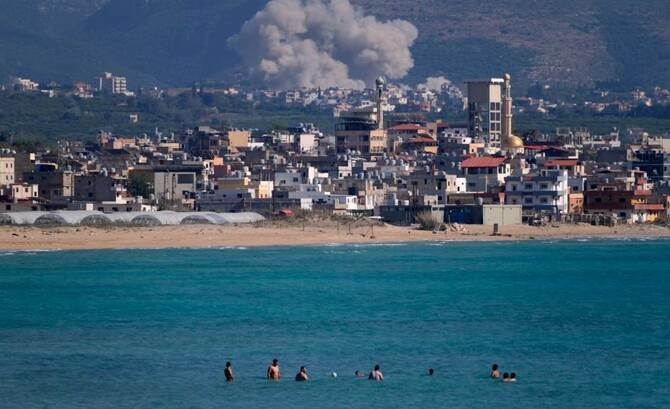
The diplomatic push came after Israel threatened to resume strikes on Beirut’s southern suburbs and Hezbollah prepared attacks deeper inside Israeli territory, raising fears of a wider confrontation. By Monday night, however, Arab and international mediation efforts had succeeded in preventing a further escalation.
US President Donald Trump later said that through what he described as “highly placed representatives,” understandings had been reached with Hezbollah to halt exchanges of fire between Israel and the Iran-backed militant group.
Hezbollah denied any direct communication with Washington. Lawmaker Ihab Hamadeh said on Tuesday that the group had not communicated with any party other than Iran, which has maintained daily contact with Berri, particularly over the past two days as Israeli threats against Beirut intensified.
A political official closely involved in Berri’s consultations told Arab News that a broader US-Iran deal would significantly improve the prospects of securing a ceasefire.
“It would enable the Lebanese delegation, during its negotiation with Israel, to secure Lebanon’s demands, including a comprehensive ceasefire,” the person said.
“What is needed is for Iran to pressure Hezbollah to halt its attacks and for the United States to pressure Israel to do the same.”
The official, who requested anonymity, said that Berri and the Amal Movement remained committed to the principle that the Lebanese state alone should negotiate on Lebanon’s behalf.
“The Lebanese state must remain the negotiating party. That principle is beyond question. But Iranian pressure on Hezbollah remains essential because it can help create the conditions necessary for a ceasefire,” the person said.
As head of the Amal Movement and Hezbollah’s closest political ally, Berri has effectively become an intermediary between the group and Washington, which continues to designate it as a terrorist organization.
Despite ongoing contacts, Lebanese officials cautioned against expectations of an immediate breakthrough. A source close to Berri said negotiations remained fluid and that attention was now focused on the outcome of the latest round of talks in Washington.
“Things need time before results take shape,” the person said. “There is a great deal of analysis and nothing is definitive yet.”
A Lebanese official following the Washington negotiations told Arab News that serious attempts were being made on Tuesday and Wednesday to reach a comprehensive ceasefire agreement, even as Israel escalated its evacuation warnings for Nabatieh, pressed on with its bombardment of the city and continued striking civilians and emergency responders.
Hezbollah, meanwhile, announced military operations that had pushed beyond southern Lebanon and into northern Israel for the first time.
“It does not matter who brings about the ceasefire,” the official said, arguing that the focus should be on ending the war rather than assigning political credit.
“This is no moment for political one-upmanship.”
He said Hezbollah had not taken steps to place what it called the resistance under state authority or singled its readiness to operate within the state’s framework.
“The doors of the presidential palace were never shut in Hezbollah’s face. It was Hezbollah that walked away,” he said.
Behind the scenes, an intense diplomatic effort has been underway since late last week. Saudi Arabia, Egypt and Qatar spearheaded Arab mediation, while Iranian, American, European and Pakistani officials worked through parallel channels.
On Tuesday, Lebanese President Joseph Aoun called on Hezbollah to come to the Presidential Palace and place what it considers points of strength under the authority of the state, urging the group to engage directly with the presidency and support negotiations with Israel rather than obstruct them.
“Those who care about Lebanon must work to ensure the success of the negotiations,” he said. “Strength does not lie in waging war but in having the courage and wisdom to end the war through negotiations in the interest of the country.”
Aoun’s remarks came only hours before a new round of direct political negotiations with Israel was due to be held in Washington, amid renewed military operations between the Israeli army and Hezbollah in southern Lebanon despite a partial ceasefire.
According to the Lebanese Embassy in Washington, the agreement would not end the conflict. But it urged Israel to refrain from strikes on Beirut and its suburbs controlled by Hezbollah and the Iran-aligned group to halt its attacks on Israel, with the ceasefire framework to be later expanded to cover all Lebanese territory.
Iranian Parliament Speaker Mohammad-Bagher Ghalibaf, who is leading Iran’s negotiations, said on Monday evening that he had told Berri during a telephone call that “if the Israeli aggression against Lebanon continues, we will not only halt the negotiations, but also move to confront the enemy directly.”
Israel, for its part, remains adamant about securing prior guarantees and security arrangements related to Hezbollah’s weapons. However, meetings hosted by the Pentagon last week between the Lebanese and Israeli military delegations failed to yield a meaningful breakthrough on either the terms of a ceasefire or the mechanisms for implementing it, as both sides held firm on their political and security demands.