Itanagar, Aug 10 (IANS) Arunachal Pradesh Chief Minister Pema Khandu on Monday urged universities across the Northeast to move beyond conventional degree‑oriented education and evolve into “problem‑solving institutions” capable of addressing the region’s developmental, social, environmental and strategic challenges.
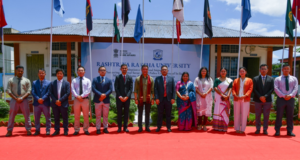
Addressing the inaugural session of the two‑day Roundtable of Vice‑Chancellors of Northeast Universities at the Rashtriya Raksha University (RRU) campus in Pasighat, Khandu said the first‑ever such roundtable in the region should lead to concrete institutional partnerships, actionable ideas and measurable outcomes rather than remain confined to deliberations.
The roundtable, themed “Transforming Higher Education: Innovations, Collaborations and Strategies for a Future‑Ready India”, brings together Vice‑Chancellors, academicians, experts and representatives of the Association of Indian Universities (AIU) and RRU.
Khandu said higher education has a particularly important role to play in a young, aspirational and geographically diverse state like Arunachal Pradesh. “Our universities must prepare our young people not only for employment, but also for entrepreneurship, innovation, research and public service, while nurturing them as responsible citizens,” he said.
He stressed that higher education in Arunachal Pradesh must respond to the state’s distinctive realities, including frontier and border‑area development, tribal communities, biodiversity, climate change, cultural preservation, rural livelihoods, tourism, connectivity and national security.
Calling for a fundamental shift in the role of universities, Khandu said research should increasingly focus on real‑life challenges faced by people. “Universities should become laboratories where local challenges are converted into research questions and research outcomes are converted into practical solutions,” he said.
He encouraged universities to establish partnerships with government departments, industries, defence and security establishments, local communities and civil society in areas such as sustainable agriculture, bamboo and cane, handloom and handicrafts, border‑area development, disaster management, eco‑tourism, renewable energy, indigenous knowledge and public health.
The Chief Minister also called for universities to become early adopters of artificial intelligence and digital technologies. He proposed AI‑enabled academic ecosystems for personalised learning, student assessment, research assistance, language technologies and administrative efficiency. For Arunachal Pradesh, he said AI could have transformative applications in remote education, multilingual learning, disaster prediction, biodiversity monitoring and healthcare delivery.
Khandu also called for joint digital repositories of indigenous knowledge, languages, oral traditions, traditional medicine, crafts and ecological practices, while ensuring community ownership and appropriate safeguards.
On internationalisation of higher education, he said it should not be limited to sending students abroad but should also involve bringing global knowledge, research partnerships, faculty collaborations and international exposure to universities in the Northeast. He encouraged universities to develop joint programmes and research partnerships with institutions in South and Southeast Asia, leveraging the region’s strategic position under India’s Act East policy.
Khandu proposed the creation of a Northeast Higher Education Consortium involving universities across the region for joint research, faculty exchange, student mobility, shared laboratories and common digital resources. He also suggested establishing Centres of Excellence for Indigenous Knowledge and Tribal Studies, involving interdisciplinary research across anthropology, science, technology, environment and economics.
“Indigenous knowledge should not be treated merely as heritage. Wherever scientifically appropriate, it should be explored for contemporary applications and livelihood generation,” he said.
Calling for stronger university‑based startup ecosystems, Khandu said institutions should become incubators of ideas and entrepreneurship rather than merely consumers of government employment. He identified tourism, agri‑business, food processing, bamboo, handicrafts, textiles, clean energy, digital services and indigenous products as areas with considerable entrepreneurial potential in Arunachal Pradesh.
Referring to RRU’s presence in Pasighat, the Chief Minister described it as a strategic opportunity for Arunachal Pradesh and the wider Northeast. He said the campus could develop into a regional centre for national security education, research and capacity building, with potential collaboration in border management, cyber security, drone technology, disaster response, forensic science, counter‑terrorism studies, community policing and strategic studies.
Emphasising the need to translate deliberations into action, Khandu suggested that each technical session identify a major challenge, three practical interventions, a lead institution and a clear implementation timeline. He also proposed that the Vice‑Chancellors’ Roundtable become an annual institutional process to ensure continuity, follow‑up and measurable progress.
The two‑day roundtable is expected to deliberate on strategies for transforming higher education in the Northeast through innovation, institutional collaboration, research, entrepreneurship, digital transformation and stronger linkages with society and the economy.