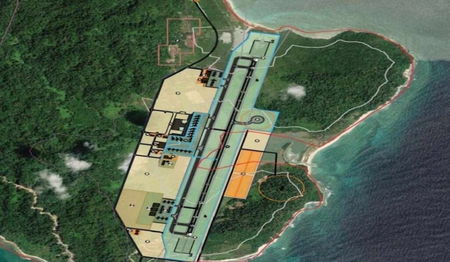
New Delhi, May 24 (IANS) The Great Nicobar Project, work on which is underway, aims to transform the island into a strategic maritime and economic hub by leveraging its proximity to the global East–West shipping route and reducing dependence on foreign transshipment ports, keeping in view India’s defence and national security, an article contended.
The project, which will strengthen India’s strategic presence in the Andaman Sea and Southeast Asia, seeks to balance port-led economic growth with calibrated environmental safeguards and protection of indigenous communities.
The port is strategically important because it is located close to the East-West international shipping route, which is about 40 nautical miles away, and has a natural water depth of over 20 metres. This strategic location gives it an advantage to attract both gateway and transhipment cargo to reduce India’s dependence on foreign ports like Colombo, Singapore, and Klang.
The project is situated near the waterway that is also crucial to China’s crude oil imports and trade flows, which is a vulnerability often described by analysts as Beijing’s “Malacca dilemma”, according to an article in the South China Morning Post.
“The Great Nicobar project is probably one of the more consequential strategic bets India has made in recent decades,” the article cites former Indian Army officer and military diplomat, Brigadier Sanjay Iyer (retd), as saying.
He pointed out that the project will give India a continuous presence in the eastern Indian Ocean, better awareness of what’s moving through the region, “and a degree of leverage that didn’t exist before”.
Iyer pointed out that Great Nicobar sits at the edge of the Strait of Malacca, which handles somewhere between a quarter and a third of the world’s seaborne trade, while for China, two-thirds of its maritime commerce and close to 70–80 per cent of its oil imports move through the strait.
“Beijing has openly worried about the ‘Malacca dilemma’, the vulnerability of having so much of its energy supply flowing through a narrow passage it doesn’t control. Great Nicobar sharpens that dilemma considerably,” Iyer said
He pointed out that the importance of Malacca as a potential chokepoint has increased since the US-Iran war, which has disrupted shipping traffic and energy exports across the Strait of Hormuz.
While India is not going to blockade the strait in peacetime, the infrastructure on Great Nicobar improves India’s ability to monitor the movement of China’s Navy, the western Pacific, and the Indian Ocean, Iyer said.
India has been underutilising the potential of the Indian Ocean, which is a vital artery for commerce and energy supplies connecting Europe, Asia and Africa, the article cites analysts as saying.
In contrast, Beijing has been building a network of overseas commercial and military infrastructure, energy pipelines, and naval facilities in Sri Lanka, Pakistan, and Djibouti to gain greater access to the Indian Ocean.
“Great Nicobar pushes India to think like a maritime power, or specifically an island power too. The Andaman and Nicobar chain is where contemporary India blends into Southeast Asia,” Uday Chandra, a professor at Ashoka University, told the South China Morning Post.
India’s ports lack deep-water berths for large ships. Because of this, cargo is routed through Colombo and Singapore. India loses substantial revenue as a result. Countries like Myanmar, China and Sri Lanka are already building deep-water facilities to capture this trade.
In this context, the International Container Transhipment Port (ICTP) at Galathea Bay is being developed as part of the Holistic Development of Great Nicobar Island under the Island Development programme. Along with the proposed airport, township, and power plant, the Galathea Bay transhipment port forms a major infrastructure component of the overall Great Nicobar Project.