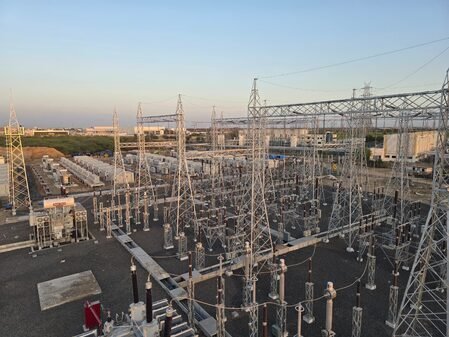
Gandhinagar, May 8 (IANS) Gujarat has expanded its battery energy storage capacity to 870 megawatts across five operational locations as part of a broader effort to manage fluctuating renewable energy output and strengthen grid stability, officials said on Friday.
The state’s latest capacity addition builds on its early adoption of Battery Energy Storage Systems (BESS), first demonstrated in Modhera in Mehsana district, which is recognised as India’s first solar-powered village where solar generation was integrated with battery storage.
Following that model, Gujarat has gradually scaled up storage infrastructure deployment across multiple locations.
According to officials, battery storage systems are now operational at five sites across the state, with recent commissioning including a facility at Charal in Sanand taluka of Ahmedabad district.
Other operational locations include Modhera and Lakpat in Kutch, bringing the cumulative installed capacity to 870 MW.
The expansion also follows earlier phased installations as part of the state’s renewable energy integration strategy.
In addition to existing projects, 13 new battery storage developments have been registered across Ahmedabad, Gandhinagar, Banaskantha, Patan and Kutch districts.
These projects are intended to further strengthen storage capacity and support the integration of renewable energy into the grid as generation from solar and wind sources continues to grow.
Officials said the primary objective of expanding battery storage is to address the variability of renewable energy generation, particularly solar power, which peaks during daylight hours but declines in the evening, when demand typically rises.
Stored electricity can be deployed during peak demand periods to reduce grid stress and maintain an uninterrupted supply.
The initiative has been incorporated into the Gujarat Integrated Renewable Energy Policy-2025, under which battery storage projects are being developed as standalone facilities and in combination with new and existing renewable energy projects.
The policy framework also provides for future integration of storage systems with industrial and commercial consumers, subject to standard operating procedures being finalised, enabling them to pair renewable generation with storage capacity.
Once the procedures are approved, registration for battery storage systems is expected to open for industrial and commercial users, allowing them to integrate such systems with their own solar or wind installations.
State authorities said planning for battery storage deployment is being carried out strategically, with a focus on locating systems near renewable energy generation sites.
This approach aims to reduce transmission losses and minimise energy waste while improving efficiency in power evacuation and storage.
The Gujarat Energy Transmission Corporation (GETCO), along with state distribution companies, is involved in identifying suitable locations based on grid capacity and operational requirements.
Officials said the storage systems are expected to play a dual role by not only storing surplus electricity but also supporting grid stability through voltage and frequency regulation, particularly during periods of high demand or sudden load fluctuations.
They will also function as emergency backup systems when required. The expansion aligns with India’s broader target of achieving 500 gigawatts of non-fossil fuel energy capacity by 2030.
Gujarat’s growing investment in battery storage infrastructure aims to facilitate greater renewable energy penetration while maintaining the reliability and stability of the power supply system.