Hyderabad, June 26 (IANS) Solemnity and mourning marked ‘Yaum-e-Ashura’, the 10th day of Muharram, as the historic ‘Bibi-ka-Alam’ procession passed off peacefully in the old city of Hyderabad amid tight security on Friday.
Thousands of mourners participated in the procession, which traditionally started from Bibi Ka Alawa and concluded at Chaderghat on the banks of the Musi River after passing through various parts of the old city.
The procession passed through Sheikh Faiz Kaman, Yakutpura Darwaza, Etebar Chowk, Charminar, Gulzar Houz, Panjeshah, Mani Mir Alam, Purani Haveli and Darulshifa.
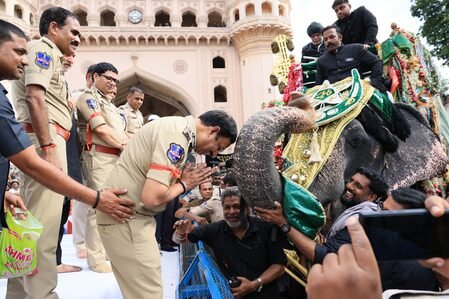
The ‘Bibi ka Alam’ was carried on a caparisoned elephant ‘Sreedevi’, brought from Kerala.
‘Yaum-e-Ashura’ or the 10th day of Muharram, the first month of the Islamic calendar, is observed in memory of the martyrdom of Prophet Mohammed’s grandson Imam Hussain and his followers at the battle of Karbala.
The gold-and-diamond-studded ‘alam’ or standard is believed to contain a piece of wooden plank on which Bibi Fatima Zehra, daughter of Prophet Mohammed, was given the final ablution.
The ‘alam’ was installed over 430 years ago during the Qutub Shahi dynasty, and the practice of carrying the ‘alam’ on an elephant has continued since then.
Groups of self-flagellating mourners led the procession.
Blood oozed out from the heads and chests of bare-chested Shia mourners who flagellated themselves with sharp-edged objects.
Amid cries of ‘Ya Hussain’ and recitation of ‘marsiya’ (elegies) and ‘noha-khwani’ (poems expressing sorrow), barefoot youths using knives, blade-encrusted chains and other sharp-edged weapons inflicted injuries on themselves to show solidarity with the sufferings of the martyrs.
Others were seen crying and beating their chests.
The police made elaborate security arrangements, deploying around 2,000 personnel.
Policemen on horses were seen piloting the procession.
Traffic was diverted at a few points for the annual procession.
Top government officials, Hyderabad Police Commissioner V. C. Sajjanar, leaders of different political parties and representatives of the family of Nizam, ruler of the erstwhile Hyderabad State, offered ‘Dhattis’ en route the procession.
The Police Commissioner personally stationed himself at the historic Charminar to supervise the security arrangements and traffic management.
Along with senior officers from the Law and Order and Traffic wings, the Commissioner offered traditional ‘Dhattis’ and floral garlands to the sacred Alam on behalf of the Hyderabad City Police, paying traditional respects.
Sajjanar told the media that robust security arrangements were in place, involving over 2,000 police personnel, to ensure the smooth conduct of the massive procession.
The Commissioner highlighted several key measures undertaken this year.
These include conducting a prior trial walk for the elephant, multi-layered security to manage crowds effectively, deployment of drone cameras for aerial surveillance along the entire route, and the presence of mounted police (horse-riding teams).
The Commissioner credited the peaceful and successful execution of the event to the seamless coordination among the Greater Hyderabad Municipal Corporation (GHMC), Hyderabad Metropolitan Water Supply and Sewerage Board (HMWSSB), and the Electricity Department.
Continuing the tradition, HEH Nizam Trust and HEH Awqaf Committee offered ‘Dhatti’ to Bibi Ka Alam at Peeli Gate (Yellow Gate), Purani Haveli.
Nawab Abul Faiz Khan, Trustee of the Mukarram Jah Trust for Education and Learning and HEH Awqaf Committee, and representing the Nawab Mir Muhammad Azmet Ali Khan, the ninth titular Nizam of Hyderabad, offered ‘Dhatti’.
He was joined by Charminar MLA Mir Zulfeqar Ali and senior officials of the Awqaf Committee.
The Sunni Muslims observed the day by fasting and holding meetings to remember the sacrifices of Imam Hussain and his followers, who were martyred in 61 Hijri or 681 CE at Karbala in present-day Iraq.
Fasting is observed on two days – the 9th and 10th, or the 10th and 11th, of Muharram.
Religious gatherings and food distribution camps were organised.
Various organisations conducted charity programmes to mark the day.