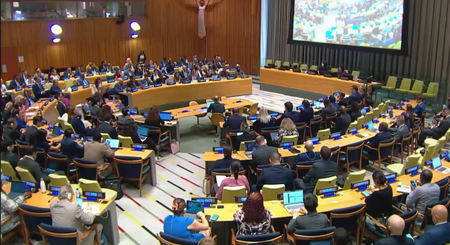
United Nations, July 28 (IANS) The General Assembly on Tuesday reenacted the annual ritual of passing on to its next session the Security Council reform negotiations, and India decried it being “held hostage by the narrow, divisive interests of a select few” countries.
India’s Permanent Representative P Harish said sarcastically, “In Indian philosophy, it is said that a soul has to go through cycles of births and deaths, making incremental progress each time, before attaining liberation. The IGN have been through seventeen cycles already. Sadly, however, there is no liberation in sight. How much longer should the world wait?”
The Assembly, with a voice vote, agreed to roll over the Inter-Governmental Negotiations (IGN) for reforms to the 81st session that will start in September.
The negotiations are bogged down while “there is a palpable sense of disappointment among Member States and global citizenry regarding the inability of the Security Council to meaningfully intervene in conflicts across the globe,” Harish said.
“Every session that we spend regurgitating our positions from the comfort of New York, the hope for a fit-for-purpose UN grows weaker in the real world,” he added.
The negotiations have been sabotaged by a 13-member group calling itself Uniting for Consensus, which is led by Italy and includes Pakistan. It uses procedural manoeuvres to create a logjam, preventing the adoption of a negotiating text unless there is a consensus, locking it in a Catch-22 situation where there cannot be progress towards a consensus without a text to guide the discussions.
Harish reiterated the demand for holding the reform discussions with a negotiating text. “The path to securing such reforms is clear – text-based negotiations with clearly defined timelines and milestones. The outcome of such a genuine effort must lead to an expansion in both categories, with greater representation of the Global South,” he said.
Speaking on behalf of G4, Japan’s Permanent Representative Yamazaki Kazuyuki said, “To truly move the reform process forward, the G4 expects that, in the next intergovernmental session, the Co-Chairs will put all their efforts into the development of a consolidated model with accurate representation of the clear facts mentioned above, and finally pave the way for text-based negotiations.”
G4 is made up of India, Brazil, Japan, and Germany, which together lobby for reforms that would include expanding the permanent membership of the Security Council.
Yamazaki said that “it is deeply regrettable” that the Elements Paper, a document that lists points in the negotiations, “continues to fail to reflect the undeniable fact that a majority of Member States support the expansion in both permanent and non-permanent categories.”
Saint Lucia’s Permanent Representative Menissa Rambally, who spoke on behalf of L69, a cross-continental group that presses reforms, said a consolidation of the reform models proposed by nations should be prepared to pave the way for text-based negotiations.
“This is a mandate for the eighty-first session, not an aspiration to be deferred indefinitely,” she said.