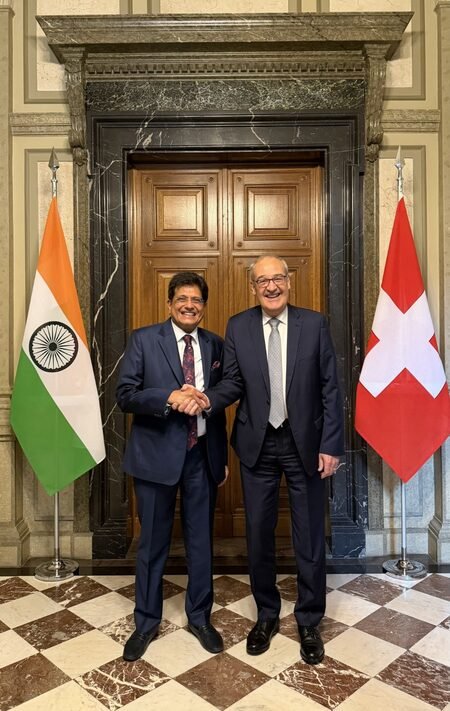
New Delhi, June 12 (IANS) Union Commerce and Industry Minister Piyush Goyal said on Friday that India and Switzerland have reaffirmed their strong and enduring partnership, with both sides committed to further strengthening economic engagement, investment flows and strategic cooperation under the India-EFTA Trade and Economic Partnership Agreement (TEPA).
In a post on social media platform X, Goyal said he had an “excellent meeting” with Guy Parmelin.
He said the discussions underscored the shared intent of both countries to deepen bilateral economic ties and advance cooperation through the TEPA framework.
“An excellent meeting with Guy Parmelin, President of the Swiss Confederation,” Goyal wrote on X.
“Our discussions reaffirmed the strong and enduring partnership between India and Switzerland, with a shared commitment to further strengthening economic engagement, investment flows, and strategic cooperation under the India-EFTA Trade and Economic Partnership Agreement (TEPA),” he added.
The meeting comes as India continues to pursue a strategy of expanding trade and investment linkages with developed economies through free trade agreements.
Earlier this week, Goyal said India’s FTAs are designed to support long-term growth by increasing global engagement, attracting capital, promoting innovation, upgrading quality standards and creating employment opportunities.
The minister had highlighted the TEPA with the European Free Trade Association as a key framework for trade, investment and innovation-led cooperation between India and member countries including Switzerland, Norway, Liechtenstein and Iceland.
According to Goyal, the EFTA countries have committed to invest $100 billion in India over a 15-year period and support the creation of one million direct jobs under the agreement.
He said India is currently in the second year of implementing the pact and discussions on investment projects are progressing actively.
The minister has repeatedly described the investment commitment as a significant component of the agreement, saying it creates a balanced arrangement that benefits both India and its partner countries while integrating India more deeply into global trade and value chains.