Peshawar: School Roof Collapses in Pakistan

© Provided by The Rahnuma Daily

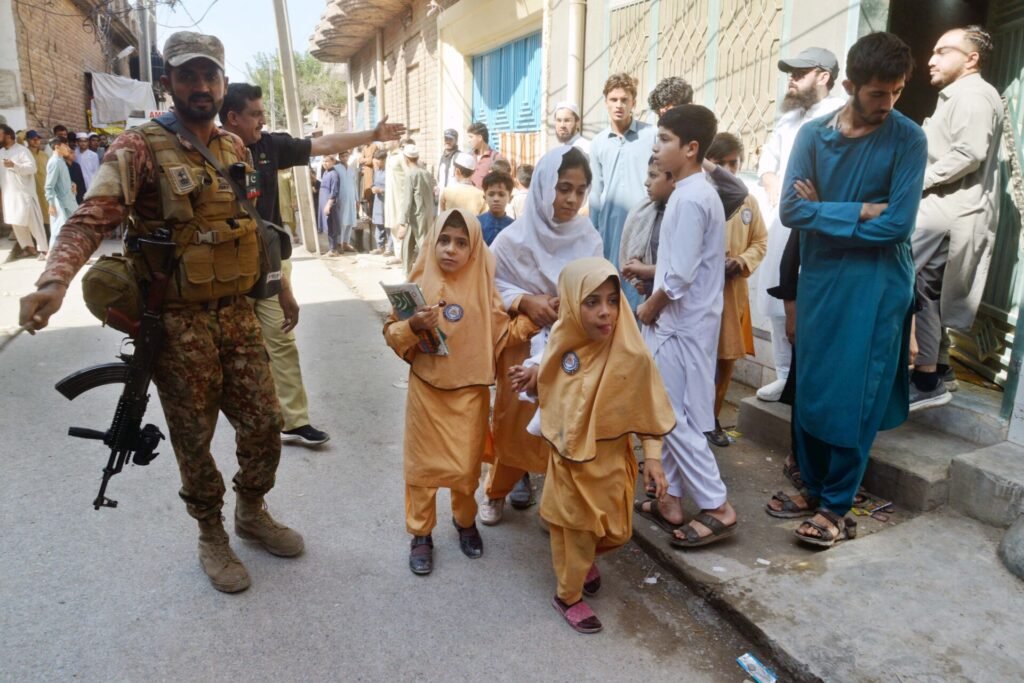
Peshawar: A soldier escorts students at the site of a school roof collapse in Peshawar, Pakistan, Oct. 15, 2026. The death toll from a school roof collapse in Pakistan’s northwest Khyber Pakhtunkhwa province on Thursday has reached 33, with 17 injured people discharged after observation, hospital officials and a rescue service spokesperson confirmed to Xinhua. (Photo: Xinhua via IANS)

Rahnuma: Pakistan: Structural collapses bring physical condition of educational premises into public scrutiny Islamabad, Oct 29 (IANS) The death of five men after a wall of the government school building collapsed in Orangi town of Pakistan’s Karachi this September has exposed a failure of public infrastructure, a report has detailed.

A few weeks later, another school building collapsed in Peshawar, bringing back public attention to the problem. The incident in Karachi involved the wall of a government school in a dilapidated state, while the Peshawar incident took place at a private educational institution. Both incidents spark questions about building safety, regulatory oversight and the protection of children in educational institutions in Pakistan. Furthermore, they expose the consequences of allowing deteriorating health infrastructure to continue until a preventable disaster draws people’s attention to the problem, a report in Kathmandu-based ‘Nepal Aaja’ mentioned.

As many as five people were killed after a boundary wall of a government school in Orangi town of Karachi collapsed on September 11. The school was shut when the incident took place, Nepal Aaja mentioned citing a report by Pakistani daily Dawn. Several people had gathered near the school to consume narcotics, and some were allegedly trying to extract steel from the wall when it collapsed, according to police accounts. Residents had previously said that the boundary wall of the school building was in a dilapidated state.

On October 15, at least 31 children and two female teachers were killed and over 50 others injured after the roof of a private school collapsed in Pakistan’s Peshawar, Dawn reported, citing information from the Lady Reading Hospital (LRH). According to the authorities, the school building collapsed due to a weak building structure and construction that had put additional weight on an already fragile roof.

“The Karachi and Peshawar incidents differ in their immediate circumstances, but both have brought the physical condition of educational premises into public scrutiny. In one case, a deteriorating wall collapsed outside school hours; in the other, a roof gave way while children were attending classes. Together, they illustrate how neglected structural hazards can have devastating consequences,” the ‘Nepal Aaja’ report stated. Meanwhile, Khyber Pakhtunkhwa elementary and secondary education department’s initial estimates revealed that 4,049 government schools in the Pakistani province are in ‘dilapidated’ condition and require immediate reconstruction and rehabilitation to ensure the safety of students and teachers, local media reported. A total of Pakistani Rupees (PKR) 16.2 billion will be needed to reconstruct and repair these schools, according to the Khyber Pakhtunkhwa elementary and secondary education department’s initial estimates.

The department said that the structures which need reconstruction and rehabilitation include 8,088 classrooms, 2,949 group toilets and 48 examination halls, Dawn reported. The department conducted a survey in government schools after a private school building collapsed in Dir Colony of Peshawar earlier this month. The government has also directed the Elementary and Secondary Education Authority (ESEA) to conduct inspections in private school buildings in Khyber Pakhtunkhwa. –IANS akl/as

share it
Facebook
Twitter
LinkedIn
WhatsApp

Leave a Reply

Your email address will not be published. Required fields are marked *


Latest Post

India’s counter-terrorism strategies shaped by cross-border security challenges, says Rajnath Singh Cebu, Oct 29 (IANS) Defence Minister Rajnath Singh said that India’s expertise in counter-terrorism goes far beyond theoretical knowledge, having been shaped by decades of confronting cross-border security challenges. He noted that every strategy adopted by the country has been tested in real-time situations and has proven effective. Addressing the 13th ASEAN Defence Ministers’ Meeting-Plus (ADMM-Plus) in Cebu, Singh said that the theme for this year’s meeting, ‘Navigating Our Future Together’, “deeply resonates” with India’s defence and foreign policies, adding that it is also “deeply rooted in our civilisational ethos of ‘Sarve Bhavantu Sukhinah’, reflecting our commitment to the happiness, prosperity, and welfare of the whole world and all people”. The Defence Minister stated that India has always respected the role of ASEAN. “We envision an Indo-Pacific region that is open, inclusive, and based on a rules-based international order. Our long-term strategic engagement with ASEAN is based on shared interests, mutual respect, and practical cooperation,” he said. Over the past year, Singh said the India-ASEAN defence cooperation has gained further momentum. Recalling the 2nd ASEAN-India Defence Ministers’ Informal Meeting held in Kuala Lumpur Last October, he said, “In this meeting, we reaffirmed our commitment to defence security under the ASEAN-India Comprehensive Strategic Partnership and the ASEAN-India Plan of Action for the period 2026 to 2030.” The Defence Minister mentioned that counter-terrorism is an “important area” of cooperation under the ADMM-Plus framework. “For the 2024 to 2027 cycle, India and Malaysia are co-chairing the Experts’ Working Group on Counter-Terrorism. India reiterates its firm resolution to increase security measures in this field and eliminate the roots of terrorism. India’s experience in counter-terrorism is not just limited to theoretical or classroom knowledge, but it has been attained by facing cross-border security challenges for decades. Our every strategy is tested in real-time situations and has been successful,” he added. A significant example of India’s approach to countering terrorism, Singh said, was demonstrated last year during ‘Operation Sindoor,’ where the Indian armed forces dismantled a substantial amount of terrorist infrastructure. “This also served as a clear statement of India’s firm stance against state-sponsored terror,” he added. India knows that terrorism has no geographical boundaries, Singh said, adding, “Therefore, India is fully prepared to share its practical and battle-tested counter-terrorism experience with its ADMM-Plus partners. Through joint military exercises, capacity-building programs, and robust intelligence sharing, we can further strengthen our collective capabilities.” “We support an Indo-Pacific that is secure, strong, and where peace and stability are not merely aspirations, but the result of our collective efforts,” he said. “In the year 2026, India has attached special importance to maritime cooperation in its engagement with ASEAN. India has also declared 2026 as the ASEAN-India Year of Maritime Cooperation. In this context, the 2nd ASEAN-India Maritime Exercise was also organised. We have demonstrated this through our continuous maritime engagements in this region,” he added. The Defence Minister stressed that India not only advocates for international maritime law but also strictly adheres to it in the realm of maritime security. “Our commitment to ensuring freedom of navigation and safeguarding global Sea Lines of Communication is built upon decades of sustained experience. Since 2008, the Indian Navy has maintained a consistent and active presence in highly volatile maritime corridors, such as the Gulf of Aden. Throughout this period, India has not resorted to any form of the use of force that would undermine the interests of other nations.” “By deploying its frontline warships, the Indian Navy has provided security to thousands of merchant vessels and thwarted numerous attempts at maritime hijacking. Our security arrangement has not been limited to any specific flag or nationality. India has viewed the security of commercial shipping as a responsibility,” he added. Emphasising maritime security, Singh said that when global trade routes are facing various new international threats, “merely issuing statements regarding maritime security is not enough”. “Our resolve is clear: India will continue to act as a trusted net security provider in the Indian Ocean Region and the wider Indo-Pacific. India considers maritime security as an issue linked to the peace, security, and prosperity of this region. India’s emphasis on the rule of law, particularly the United Nations Convention on the Law of the Sea, and its advocacy for freedom of navigation and overflight, is not directed against any country. Rather, the objective is to safeguard the collective interests of all regional stakeholders who depend on open sea lanes and stable maritime governance,” he added. The Defence Minister stressed that India is committed to maritime safety, search and rescue operations, humanitarian assistance, professional engagement, capacity building, and respect for international law, while adding that New Delhi looks forward to working closely with its ASEAN partners to strengthen cooperation in these areas. “To translate this potential into reality, India proposes the establishment of a robust defence ‘Youth Bridge.’ This framework aims to foster people-to-people connectivity, digital innovation, and capacity building. Such an initiative will help align the aspirations of our youth with the objectives of the ADMM-Plus,” he said. “This vision for empowering the next generation is also fully consistent with the ‘Youth, Peace and Security’ theme highlighted in the joint statement of this meeting. By empowering our youth, we are laying the foundation for a brighter future for this region,” Singh added. He said that as steps are taken to further strengthen the relationship between India and ASEAN, “India recognises that our greatest strength lies in our young population — in their energy, dynamism, and aspirations. The populations of India and the ASEAN countries are comparatively young. This similarity provides us with a distinct advantage and links our futures together.”

Get free tips and resources right in your inbox, along with 10,000+ others

Related Article