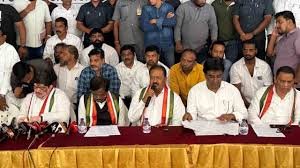
Hyderabad, May 10 (RAHNUMA): Advisor to Telangana Government Mohammed Ali Shabbir played a key role in securing the allotment of 10 acres of land worth more than Rs. 20 crore for a Muslim burial ground in Kamareddy district, with the Telangana Government issuing an official Gazette notification for the allocation.
The land measuring Ac.10.00 guntas in Survey No. 325/61/2 at Kyasampally village in Kamareddy district was allotted to the Telangana Waqf Board for the burial of Muslim dead bodies. The notification was published in the Telangana Gazette dated April 16, 2026 under the provisions of the Waqf Act, 1995.
Sources said the initiative was part of efforts to ensure availability of adequate burial grounds for Muslims in every district of Telangana, beginning with Kamareddy, the hometown district of Mohammed Ali Shabbir.
Shabbir Ali has been associated with several major initiatives relating to minority welfare over the past three decades. He had the distinction of creating India’s first Minority Welfare Department in united Andhra Pradesh in 1993 after becoming a Minister for the first time at the age of 32.
It was during 1993-94 that the then Andhra Pradesh Government introduced a separate minority welfare budget for the first time in history with an allocation of Rs. 2 crore. Over the years, the allocation witnessed a steady increase and the combined minority welfare budgets of Telangana and Andhra Pradesh for 2026-27 now stand at nearly Rs. 7,000 crore.
Shabbir Ali also played a significant role in introducing four per cent reservation for Muslims in education and employment under the BC-E category, which has reportedly benefited nearly 22 lakh economically weaker Muslims.
Officials recalled that the first appointment letter issued to a Muslim candidate under the BC-E reservation category was given by the Genco Department, which was under the control of then Energy Minister Mohammed Ali Shabbir during 2006-07.
During the Congress Government between 2004 and 2009, Shabbir Ali played a major role in establishing pre-matric and post-matric hostels, English-medium residential schools for minorities which later evolved into the Telangana Minorities Residential Educational Institutions Society (TMREIS), and Muslim mass marriage schemes which later took shape as Shaadi Mubarak.
The latest Gazette notification is being viewed as another significant step in the continuing expansion of minority welfare infrastructure in Telangana.