LONDON(RAHNUMA): The government of the Syrian Arab Republic is committed to expanding cooperation with the World Bank to advance financial, economic and institutional reforms, Finance Minister Mohammed Yisr Barnieh said on Thursday.
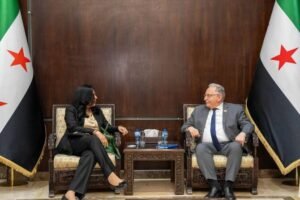
Barnieh met Dahlia Khalifa, the World Bank’s Middle East director, in Damascus to discuss economic and financial reforms, social protection and sustainable development programs, according to the Finance Ministry.
The sides discussed accelerating projects already approved under existing grants and reviewed proposed changes to Syria’s pension, retirement and social insurance systems, including restructuring the institutions that oversee them.
Housing finance was also a major focus. Officials considered updates to mortgage finance laws and instruments, development of the country’s mortgage finance system and Real Estate Finance Supervisory Authority, and ways to expand access to affordable home loans, the Syrian Arab News Agency reported.
The talks also covered efforts to improve governance, performance and competitiveness at state-owned economic and financial institutions. Those measures included gradually converting some entities into joint-stock companies and restructuring state-owned financial institutions as part of the broader reform agenda.
In addition, the discussions covered fiscal policy, economic growth and the Finance Ministry’s broader strategy. Officials considered potential World Bank support for improving livelihoods and strengthening social protection programs, with an emphasis on better targeting aid to those most in need.
The meeting also addressed digital transformation in financial institutions and plans for a public-private partnership knowledge center to support development projects.
Officials discussed the “Syria Without Camps” initiative, part of the country’s recovery plan, and potential World Bank support for the voluntary and safe return of displaced Syrians to their home areas through multisector projects, the ministry said.
Improving Syria’s business climate and investment environment was also on the agenda. World Bank representatives said they would continue providing technical support and prepare specialized missions to Damascus to assist financial reform and economic development efforts, according to the ministry.
The meeting came a week after the World Bank approved a $100 million International Development Association grant to help Syria establish the foundations of a modern, secure and digitally enabled financial sector.
After about 14 years of civil war, Syria’s financial sector remains small, bank-centered and heavily reliant on cash, with limited financial intermediation, outdated digital-payment infrastructure and weaknesses in supervision, financial integrity and financial-stability systems, the World Bank said on Aug. 7.
Those constraints raise transaction costs, restrict access to finance, and hinder Syria’s reconnection to international financial channels needed for trade and investment, the bank added.
A functioning financial system is essential for recovery, enabling wage and pension payments, remittances, business transactions, trade and investment, and the secure, transparent delivery of humanitarian and development aid.