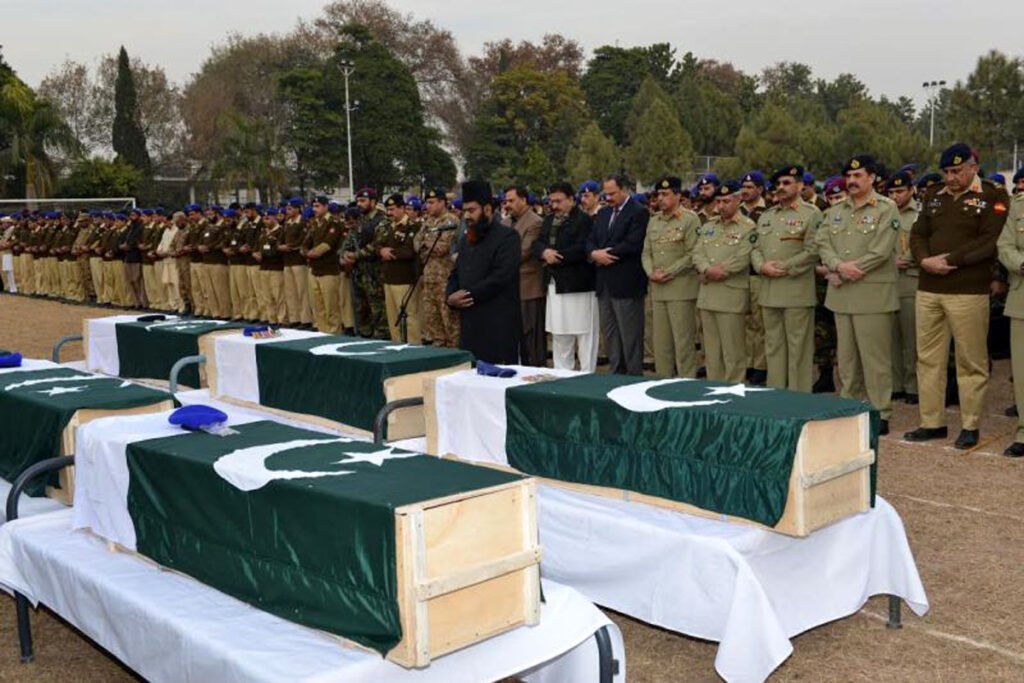
The funeral of the victims killed in a suicide bomb blast in Rawalpindi

© Provided by The Rahnuma Daily

(140120) — RAWALPINDI, Jan. 20, 2014 (Xinhua) — Photo released by Pakistan Armed Forces Inter-Services Public Relations (ISPR) shows army officials mourn during the funeral of the victims killed in a suicide bomb blast in Rawalpindi, Pakistan, Jan. 20, 2014. At least 13 people were killed and over 20 others injured when a suicide bomber blew himself up near a police check post jointly owned by police and Pakistan army on Monday morning , officials said. (Xinhua/ISPR) (djj)

Rahnuma:Pakistani forces and army-backed ‘death squads’ suffer major casualties in Balochistan Quetta, Oct 29 (IANS) Pakistani forces and government-backed elements, including the ‘death squads’ outsourced by the Pakistan Army and intelligence agencies, have suffered heavy casualties during armed attacks carried out on them in various areas of Balochistan province, local media reported on Thursday.

The attacks were carried out in Basima, Panjgur, and Turbat, Balochistan Post reported citing local sources. “Armed men ambushed a convoy of forces near the Sajid area of ​​Basima yesterday. According to local sources, the forces suffered casualties and two vehicles were also severely damaged in the attack. Sources further said that clashes continued in the area for more than two hours, while helicopters later arrived to reinforce the forces,” the report mentioned. It added that a convoy of forces was also targeted in an armed attack in the Gwargo area of ​​Panjgur on Wednesday when three vehicles of the Pakistani forces were passing through the area. “Authorities have not released any details about casualties in the attacks. Additionally, this morning, gunmen targeted members of the Pakistani army-backed ‘Death Squad’ in the Noduz area of ​​Turbat.

Firing was heard for a long time in the area. No details have yet been received regarding casualties in the incident,” the report mentioned. Earlier this week, the Balochistan Liberation Front (BLF) claimed responsibility for killing over 80 Pakistani military and intelligence personnel in a series of attacks targeting a Frontier Works Organisation (FWO) camp and other military and police installations in Balochistan’s Gwadar district. In a statement, BLF spokesperson Major Gwahram Baloch said the fatalities during the group’s ‘Operation Almas’ included a Military Intelligence (MI) captain, Inter-Services Intelligence (ISI) officers and Special Services Group (SSG) personnel. He also claimed that dozens of others sustained serious injuries, The Balochistan Post reported.

According to Gwahram Baloch, the operation was launched on October 22, when the group carried out a vehicle-borne suicide attack at the entrance of the FWO camp. The explosion blew up the main gate and nearby positions, allowing other fighters to enter the compound, he said. The spokesperson claimed that after entering the FWO premises, the fighters stormed an ISI office, killing an officer and five other personnel. In a separate clash at another office, six Military Intelligence (MI) personnel, including a captain, were killed, he added.

The fighters subsequently targeted a multi-storey residential barracks and took up positions inside the building, according to the statement. “In total, 21 personnel were killed in the fighting in these barracks,” Gwahram Baloch said. He said that Pakistani forces engaged in nine more clashes overnight while attempting to regain control of the compound, followed by mortar and artillery fire. The spokesperson claimed that a fresh military offensive involving additional troops and armoured vehicles the following morning was also repelled, leaving around 13 personnel dead and two armoured vehicles destroyed. According to the statement, the fighters shot down four quadcopters and two surveillance drones during the operation. It also claimed that the group’s sniper team killed six Pakistani military personnel over the course of the operation. “The FWO and other so-called development institutions are in fact the commercial and military arms of this occupying army, used to loot our resources, guard international exploitative companies and change our demography,” said Gwahram Baloch. He said the organisation was “not against any outside power or country”, but opposed Pakistan’s control over Balochistan and what it described as the exploitation of the region’s coastline and natural resources. Baloch said that the group would continue to target the China–Pakistan Economic Corridor (CPEC), Reko Diq, Saindak and other projects in Balochistan. He warned that any project undertaken in Pakistan without the consent of the Baloch people would be vulnerable to attacks, adding that foreign institutions would bear responsibility for their losses. –IANS /as

share it
Facebook
Twitter
LinkedIn
WhatsApp

Leave a Reply

Your email address will not be published. Required fields are marked *


Latest Post

India’s counter-terrorism strategies shaped by cross-border security challenges, says Rajnath Singh Cebu, Oct 29 (IANS) Defence Minister Rajnath Singh said that India’s expertise in counter-terrorism goes far beyond theoretical knowledge, having been shaped by decades of confronting cross-border security challenges. He noted that every strategy adopted by the country has been tested in real-time situations and has proven effective. Addressing the 13th ASEAN Defence Ministers’ Meeting-Plus (ADMM-Plus) in Cebu, Singh said that the theme for this year’s meeting, ‘Navigating Our Future Together’, “deeply resonates” with India’s defence and foreign policies, adding that it is also “deeply rooted in our civilisational ethos of ‘Sarve Bhavantu Sukhinah’, reflecting our commitment to the happiness, prosperity, and welfare of the whole world and all people”. The Defence Minister stated that India has always respected the role of ASEAN. “We envision an Indo-Pacific region that is open, inclusive, and based on a rules-based international order. Our long-term strategic engagement with ASEAN is based on shared interests, mutual respect, and practical cooperation,” he said. Over the past year, Singh said the India-ASEAN defence cooperation has gained further momentum. Recalling the 2nd ASEAN-India Defence Ministers’ Informal Meeting held in Kuala Lumpur Last October, he said, “In this meeting, we reaffirmed our commitment to defence security under the ASEAN-India Comprehensive Strategic Partnership and the ASEAN-India Plan of Action for the period 2026 to 2030.” The Defence Minister mentioned that counter-terrorism is an “important area” of cooperation under the ADMM-Plus framework. “For the 2024 to 2027 cycle, India and Malaysia are co-chairing the Experts’ Working Group on Counter-Terrorism. India reiterates its firm resolution to increase security measures in this field and eliminate the roots of terrorism. India’s experience in counter-terrorism is not just limited to theoretical or classroom knowledge, but it has been attained by facing cross-border security challenges for decades. Our every strategy is tested in real-time situations and has been successful,” he added. A significant example of India’s approach to countering terrorism, Singh said, was demonstrated last year during ‘Operation Sindoor,’ where the Indian armed forces dismantled a substantial amount of terrorist infrastructure. “This also served as a clear statement of India’s firm stance against state-sponsored terror,” he added. India knows that terrorism has no geographical boundaries, Singh said, adding, “Therefore, India is fully prepared to share its practical and battle-tested counter-terrorism experience with its ADMM-Plus partners. Through joint military exercises, capacity-building programs, and robust intelligence sharing, we can further strengthen our collective capabilities.” “We support an Indo-Pacific that is secure, strong, and where peace and stability are not merely aspirations, but the result of our collective efforts,” he said. “In the year 2026, India has attached special importance to maritime cooperation in its engagement with ASEAN. India has also declared 2026 as the ASEAN-India Year of Maritime Cooperation. In this context, the 2nd ASEAN-India Maritime Exercise was also organised. We have demonstrated this through our continuous maritime engagements in this region,” he added. The Defence Minister stressed that India not only advocates for international maritime law but also strictly adheres to it in the realm of maritime security. “Our commitment to ensuring freedom of navigation and safeguarding global Sea Lines of Communication is built upon decades of sustained experience. Since 2008, the Indian Navy has maintained a consistent and active presence in highly volatile maritime corridors, such as the Gulf of Aden. Throughout this period, India has not resorted to any form of the use of force that would undermine the interests of other nations.” “By deploying its frontline warships, the Indian Navy has provided security to thousands of merchant vessels and thwarted numerous attempts at maritime hijacking. Our security arrangement has not been limited to any specific flag or nationality. India has viewed the security of commercial shipping as a responsibility,” he added. Emphasising maritime security, Singh said that when global trade routes are facing various new international threats, “merely issuing statements regarding maritime security is not enough”. “Our resolve is clear: India will continue to act as a trusted net security provider in the Indian Ocean Region and the wider Indo-Pacific. India considers maritime security as an issue linked to the peace, security, and prosperity of this region. India’s emphasis on the rule of law, particularly the United Nations Convention on the Law of the Sea, and its advocacy for freedom of navigation and overflight, is not directed against any country. Rather, the objective is to safeguard the collective interests of all regional stakeholders who depend on open sea lanes and stable maritime governance,” he added. The Defence Minister stressed that India is committed to maritime safety, search and rescue operations, humanitarian assistance, professional engagement, capacity building, and respect for international law, while adding that New Delhi looks forward to working closely with its ASEAN partners to strengthen cooperation in these areas. “To translate this potential into reality, India proposes the establishment of a robust defence ‘Youth Bridge.’ This framework aims to foster people-to-people connectivity, digital innovation, and capacity building. Such an initiative will help align the aspirations of our youth with the objectives of the ADMM-Plus,” he said. “This vision for empowering the next generation is also fully consistent with the ‘Youth, Peace and Security’ theme highlighted in the joint statement of this meeting. By empowering our youth, we are laying the foundation for a brighter future for this region,” Singh added. He said that as steps are taken to further strengthen the relationship between India and ASEAN, “India recognises that our greatest strength lies in our young population — in their energy, dynamism, and aspirations. The populations of India and the ASEAN countries are comparatively young. This similarity provides us with a distinct advantage and links our futures together.”

Get free tips and resources right in your inbox, along with 10,000+ others

Related Article