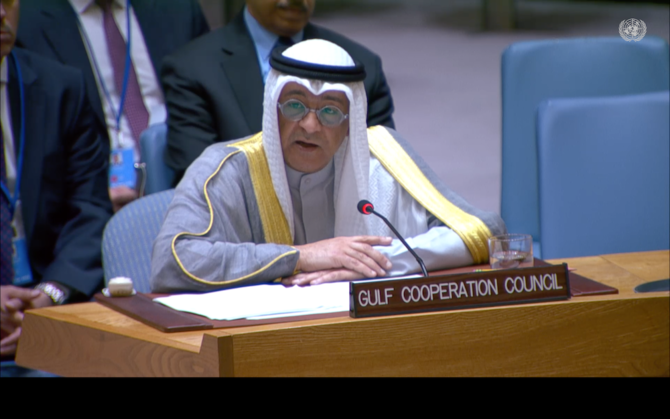
NEW YORK(RAHNUMA): In the first-ever briefing by a Gulf Cooperation Council secretary-general to the UN Security Council, Jassim Albudaiwi condemned Iranian aggression over a wave of ballistic missile and drone strikes since Feb. 28 aimed at critical infrastructure across member states and Jordan.
“These attacks have targeted civilian and vital facilities, including airports, oil installations, ports, and residential areas,” Albudaiwi said. “They constitute a flagrant violation of sovereignty and international law.”
He added: “Targeting civilians and civilian assets is a grave breach of international humanitarian law and cannot be justified under any circumstances.”
Albudaiwi welcomed the adoption of Security Council Resolution 2817 condemning the attacks and called for its full implementation to ensure accountability.
He reiterated that Gulf states reserve their right to self-defense under the UN Charter, while maintaining that “dialogue and diplomacy remain the best path to resolving crises.”
The GCC secretary-general warned Security Council members that the impact of the escalation extends far beyond the region, with maritime navigation and global supply chains also affected.
“Disruptions to maritime navigation do not stop at the borders of GCC states,” he said. “They now affect many countries around the world suffering shortages of oil, gas, fertilizers, and petrochemicals.”
He urged the Security Council to “assume its full responsibility” in protecting key waterways and ensuring the safe flow of international trade.
The meeting comes as Bahrain takes the helm of the council for the month of April, with its signature opening meeting intended to discuss the cooperation between the UN and the GCC.
Albudaiwi said the session was a turning point in relations between the two bodies, describing it as “a new beginning” for deeper coordination in maintaining international peace and security.
“The GCC has never been a party to crises,” he said. “Instead, it has championed peaceful solutions based on dialogue and diplomacy.”
He highlighted the evolution of GCC-UN cooperation since 1981, including formal agreements with UN agencies and growing coordination in crisis response.
Albudaiwi detailed aspects of this cooperation focusing on regional conflicts and emphasizing Saudi Arabia’s diplomatic leadership.
He hailed the bloc’s “unwavering support” for the Palestinian cause and praised Saudi efforts in advancing a two-state solution.
“We commend the efforts of the Kingdom of Saudi Arabia, chair of the Arab and Islamic ministerial committee on Gaza,” he said. “Its leadership led to the adoption of the New York Declaration supporting the two-state solution.”
He also pointed to Qatar’s mediation efforts to secure a ceasefire and facilitate humanitarian aid deliveries.
On Yemen, the GCC reiterated its support for a comprehensive political solution under UN auspices, based on established frameworks, including Security Council resolutions and the GCC initiative.
Regarding Lebanon, Albudaiwi called for full respect of sovereignty and implementation of international resolutions, while condemning recent violence that has caused mass casualties, widespread displacement, and extensive damage to infrastructure.
On Syria, he highlighted GCC efforts to support reintegration, reconstruction, and economic recovery, including initiatives to rebuild key sectors and restore stability.
He also referenced broader GCC engagement in regional crises, including humanitarian and development support in countries such as Sudan.
Albudaiwi said that GCC states collectively contributed more than $14 billion in humanitarian aid between 2020 and 2025, placing them among the world’s leading donors.
He underscored the Gulf’s central role in the global economy, warning that instability in the region has immediate worldwide consequences.
“Any disruption in the Gulf immediately affects global markets,” he said. “Stability in the Arabian Gulf is not merely a regional concern, but a global necessity.”
Concluding his remarks, he warned that the international community faces a defining moment.
“We stand at a crossroads,” he said. “Either collective security prevails, or we leave the world vulnerable to the rule of force.”
He added: “We extend our hand in peace, yet we will not compromise our security, sovereignty, or regional stability.”