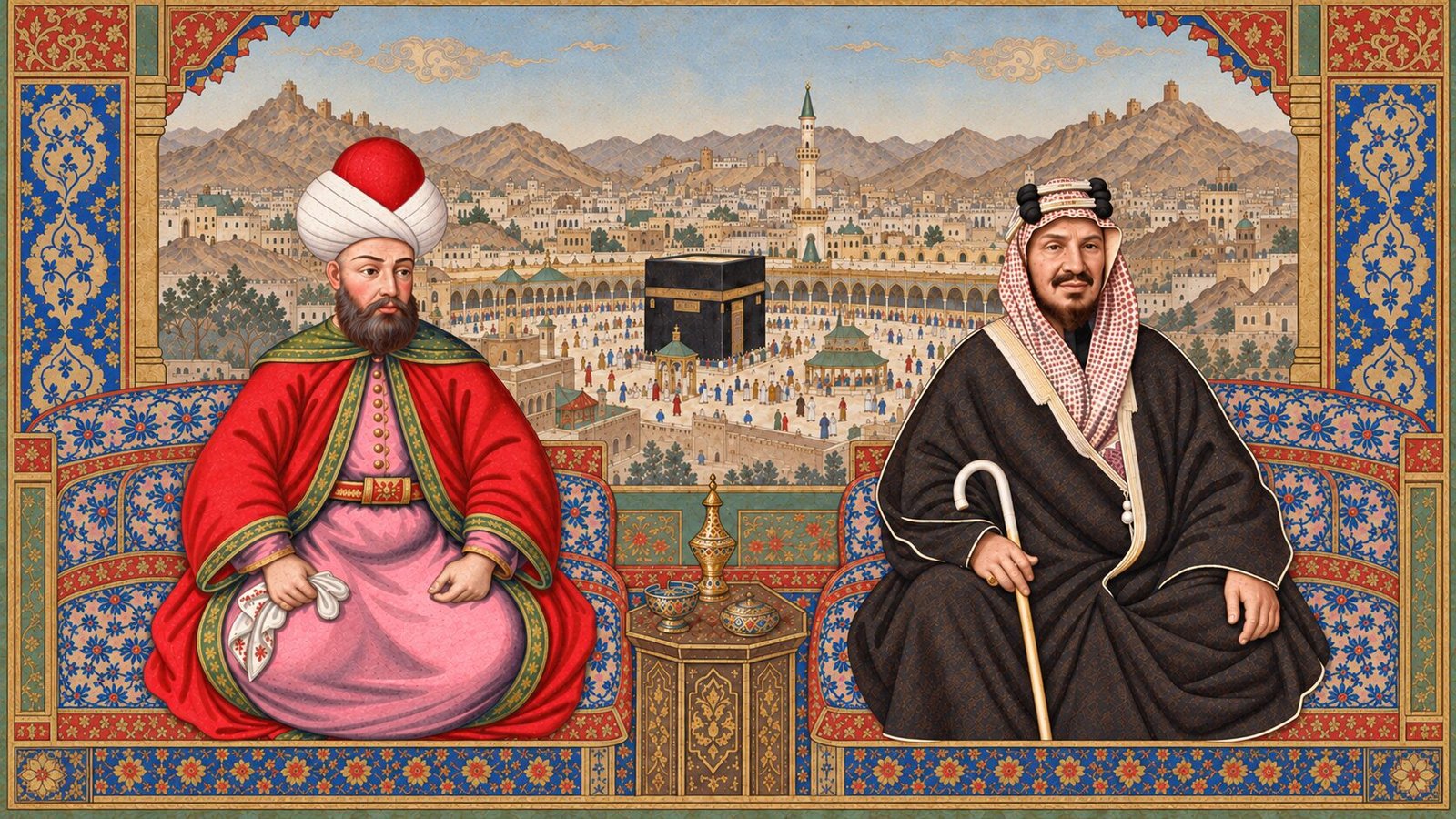
(RAHNUMA) The House of Saud today commands wealth on a scale the Ottoman sultans could scarcely have imagined. Under the broadest calculations, the disparity may approach a thousandfold.
Yet wealth alone has never made a civilization.
The Ottoman sultans possessed vastly less, but transformed enormous resources into mosques, madrasas, libraries, hospitals, fountains, public kitchens, caravanserais and charitable endowments. They patronized scholars, calligraphers, architects, physicians and craftsmen. From Istanbul to Damascus, Jerusalem, Cairo and the Hijaz, their answer to wealth remains visible centuries later—in stone, ink, beauty and institutions that survived their empire.
They were imperfect rulers of an imperfect state. But they understood something fundamental: Muslim sovereignty carried an obligation not only to govern Muslim lands, but to preserve, beautify and transmit Muslim civilization.
What, then, has the House of Saud done with infinitely greater means?
Oil presented Saudi Arabia with an opportunity perhaps unprecedented in Muslim history. At precisely the moment when the old Muslim empires and royal patrons had disappeared, Saudi wealth could have sustained what political power no longer could: the great schools of Islamic thought, historic universities, endangered manuscripts, sacred architecture, traditional scholarship, philosophy, medicine, calligraphy, music, literature and the diverse religious cultures of a civilization extending from West Africa to Southeast Asia.
Saudi Arabia could have become the greatest patron of Muslim civilization in modern history.
Instead, for decades, it devoted immense resources to exporting its own narrow religious interpretation.
This is not merely an accusation made by theological opponents. A 2005 report by the United States Government Accountability Office recorded that government and independent sources had linked Saudi funding and the international dissemination of the Kingdom’s dominant religious interpretation with the growth of extremism. It also documented concerns that Saudi-supported organizations promoted ideas later employed by violent movements.
There was also the disastrous history of jihadism. Saudi Arabia and the United States became major sponsors of the Afghan mujahideen against the Soviet Union. Later, Saudi individuals and Saudi-based charities emerged as important sources of financing for extremist organizations. American investigations did not find persuasive evidence that the Saudi government, as an institution, knowingly financed al-Qaeda—and that distinction must be preserved even in the strongest criticism of Saudi policy.
But the larger civilizational failure remains.
Saudi wealth and religious influence could have been used to strengthen Muslim civilization in all its legitimate diversity. Too often, instead, they were used to determine which parts of that civilization were sufficiently Islamic to be permitted to survive.
Even the physical inheritance of Mecca and Medina was not immune. Historic buildings and sites associated with the earliest centuries of Islam disappeared through a combination of theological hostility toward shrines and monumental commemoration, administrative neglect and the immense redevelopment demanded by modern pilgrimage. Whatever disputed figure one accepts for the number of sites lost, the transformation has been staggering.
The Two Holy Mosques may be administered by a kingdom, but their historical and spiritual inheritance belongs emotionally to the entire Ummah.
Then came the remarkable reversal.
After generations of policing Muslim culture in the name of religious purity, Saudi Arabia under Vision 2030 began spending lavishly on international entertainment, luxury tourism, professional sport, global popular culture and monumental development.
Apparently Muslim tradition required theological supervision, while Western commercial culture required an investment strategy.
The financial priorities are equally revealing.
Saudi Arabia announced a package of investment and procurement with the United States valued at approximately $600 billion in 2025. Crown Prince Mohammed bin Salman subsequently indicated that Saudi investment commitments in America could eventually rise to $1 trillion.
Saudi capital has also entered Israeli technology through international investment structures. Most strikingly, the Saudi Public Investment Fund committed $2 billion to Jared Kushner’s Affinity Partners—the firm established by one of the principal architects of the Abraham Accords—which has itself invested in Israeli companies.
None of this means Muslim capital should never enter America, technology, international finance, sport, entertainment or businesses connected to Israel. That is not the argument.
The question is one of proportion, responsibility and civilizational purpose.
Hundreds of billions can be mobilized to strengthen foreign economies. Billions can enter international investment funds. Vast sums can acquire sporting influence, entertainment properties, artificial islands and futuristic cities.
Where is the comparable project for Muslim civilization?
Where is the trillion-dollar Islamic intellectual renaissance?
Where are the great international endowments preserving manuscripts from Hyderabad to Timbuktu? Where is the restoration of historic Muslim cities from Fez and Cairo to Damascus and Lahore? Where are the universities bringing together Hanafi, Shafi‘i, Maliki, Hanbali, Ja‘fari, Ibadi, Zaydi, Sufi and other intellectual traditions without imposing theological conformity?
Where are the academies of Islamic architecture, philosophy, medicine, history, astronomy, calligraphy, poetry and the arts?
Where is the determination to make the Muslim world beautiful again?
This question is particularly serious because the Saudi monarch bears the title Custodian of the Two Holy Mosques.
Custodianship is not ownership. It implies trusteeship.
Possession of enormous wealth alongside responsibility for Mecca and Medina created an extraordinary historical opportunity: the House of Saud could have become the universal patron of Muslim civilization without claiming to be its ruler or theological policeman.
Much of that opportunity has been squandered—but it has not yet been lost entirely.
The House of Saud can still change the judgment of history. It can still restore legitimacy in Muslim hearts. But public relations campaigns, sporting spectacles and diplomatic influence will not be enough. Legitimacy must be earned by service.
Saudi Arabia should begin by establishing a permanent and independently administered Endowment for Muslim Civilization, capitalized on the scale of its commitments abroad. Even one-tenth of the sums contemplated for investment in the United States could create the largest cultural and educational endowment in Islamic history.
Its governance should not be monopolized by Saudi officials or one school of theology. Its trustees should include respected scholars, historians, architects, scientists, artists, archivists and community representatives from across the Muslim world.
Its purpose should be civilizational preservation—not ideological expansion.
First, the Kingdom should undertake a comprehensive preservation program for Mecca and Medina. Every surviving historic structure, manuscript collection, cemetery, archaeological layer and site connected to the earliest Muslim community should be professionally documented and protected. Development around the Holy Mosques may be necessary, but demolition should no longer be the automatic answer to modernity.
Where physical preservation is genuinely impossible, there must at least be archaeological excavation, digital reconstruction, museum-quality documentation and transparent consultation with international Muslim scholars and heritage specialists.
Second, Saudi Arabia should build world-class museums and research institutes in Mecca and Medina dedicated to the history of Islam—not merely the history of the Saudi state. These institutions should acknowledge the full succession of Muslim civilizations that served the Holy Cities: Umayyad, Abbasid, Fatimid, Ayyubid, Mamluk, Ottoman, Hashemite and Saudi.
To preserve history honestly is not to weaken the present dynasty. It is to demonstrate that the dynasty understands itself as one custodian in a sacred historical continuum.
Third, the Kingdom should create a worldwide rescue program for Islamic manuscripts. Collections in Hyderabad, Timbuktu, Sana’a, Cairo, Damascus, Baghdad, Sarajevo, Istanbul, Fez and countless smaller centres remain vulnerable to war, humidity, fire, neglect and illicit sale.
Saudi wealth could catalogue, conserve and digitize millions of manuscripts while leaving ownership with their communities. A universal digital library of Islamic civilization—freely accessible to scholars and the public—would be a monument greater than any skyscraper.
Fourth, Saudi Arabia should end the era of enforcing theological uniformity abroad. It should replace networks built to export one interpretation with institutions dedicated to preserving the full breadth of recognized Muslim scholarship.
A genuine international university in Medina could house faculties representing the major Sunni and Shi‘a schools, Ibadi scholarship, Islamic philosophy, Sufism, Qur’anic studies, comparative law, history and the sciences. Its purpose would not be to erase disagreement, but to teach Muslims how their civilization historically contained disagreement without destroying itself.
Fifth, the House of Saud should create a restoration fund for the historic cities of Islam. Mosques, madrasas, libraries, bazaars, gardens, palaces, caravanserais, observatories and traditional neighbourhoods should be restored in partnership with local institutions and communities.
This would not be charity alone. It would create employment for thousands of architects, conservators, tile-makers, woodcarvers, calligraphers, stoneworkers and traditional craftsmen. It would restore living cultural economies, not merely produce monuments for tourists.
Sixth, Saudi Arabia should revive the institution that sustained Muslim civilization for centuries: the waqf.
A new generation of independently protected endowments could finance schools, hospitals, scholarships, public kitchens, orphanages, libraries, women’s education, scientific research and environmental protection throughout the Muslim world. These institutions should be governed transparently and insulated from political or sectarian manipulation.
Seventh, the Kingdom should establish a Muslim civilizational reconstruction fund for countries devastated by war. Yemen, Syria, Iraq, Palestine, Libya, Sudan and Afghanistan do not need ideology exported to them. They need universities rebuilt, libraries restored, hospitals equipped, children educated and historic cities rescued from ruin.
Few acts would do more to repair Saudi Arabia’s reputation than using its wealth visibly and consistently to heal societies damaged by decades of regional conflict.
Finally, the House of Saud should convene an annual Council of Muslim Civilization in Mecca or Medina—not as a political summit and not as an instrument of religious control, but as a gathering of scholars, cultural custodians, universities, museums, historic families, craftsmen and charitable institutions.
Its mandate should be simple: identify what Muslim civilization is in danger of losing and mobilize the resources to save it.
This would represent more than a change in spending. It would require a change in attitude.
The House of Saud must stop behaving as though custodianship of the Holy Mosques grants it ownership over Islam. It should understand that the title imposes a debt to the entire Ummah.
That debt cannot be repaid by enlarging airports and hotels alone. Efficient pilgrimage administration is necessary, but the sanctuaries are not merely destinations processing millions of visitors. They are the spiritual heart of a civilization with fourteen centuries of memory.
Nor can legitimacy be purchased through football clubs, boxing matches, music festivals, celebrity appearances or architectural spectacle. Such projects may serve economic diversification, but they cannot substitute for civilizational responsibility.
The House of Saud still possesses the resources to make amends.
It can preserve what remains of the sacred history of the Hijaz. It can replace theological domination with intellectual generosity. It can protect the schools and traditions it once marginalized. It can restore the cities, manuscripts and institutions of the Muslim world. It can become known not merely as the dynasty that possessed oil, but as the dynasty that used oil to rescue a civilization.
This would not require abandoning Vision 2030. It would require giving Vision 2030 a soul.
The Ottoman sultans possessed perhaps a thousandth of the wealth now associated, under the broadest calculations, with the House of Saud. Yet centuries after their deaths, we still enter their mosques, consult their libraries, admire their calligraphy, cross their bridges and study in institutions descended from their waqfs.
The House of Saud possesses vastly more.
It has financed religious ideology. It participated in the geopolitics of jihadism and later in the campaign against it. It has poured capital into America, international finance, technology, sport, entertainment and the ambitions of Vision 2030.
But history will ask a painfully simple question:
Where is its civilization?
When the oil is exhausted, investment portfolios have changed hands and today’s spectacles have been forgotten, what will remain?
There is still time for the answer to change.
There is still time for the House of Saud to become the patron Muslim civilization needed after the fall of its old empires. There is still time to exchange religious policing for cultural stewardship, destruction for preservation, ideological conformity for intellectual confidence and spectacle for enduring beauty.
But time is not unlimited.
A dynasty can possess the Holy Cities while gradually losing its place in Muslim hearts. Wealth can command attention, but only service commands affection. Power can demand recognition, but only trusteeship earns legitimacy.
For a dynasty calling itself Custodian of the Two Holy Mosques, history will not merely ask how rich it became.
It will ask what, with all that wealth, it did to protect, restore, beautify and uplift the civilization of the people whose holiest sanctuaries it was entrusted to guard.