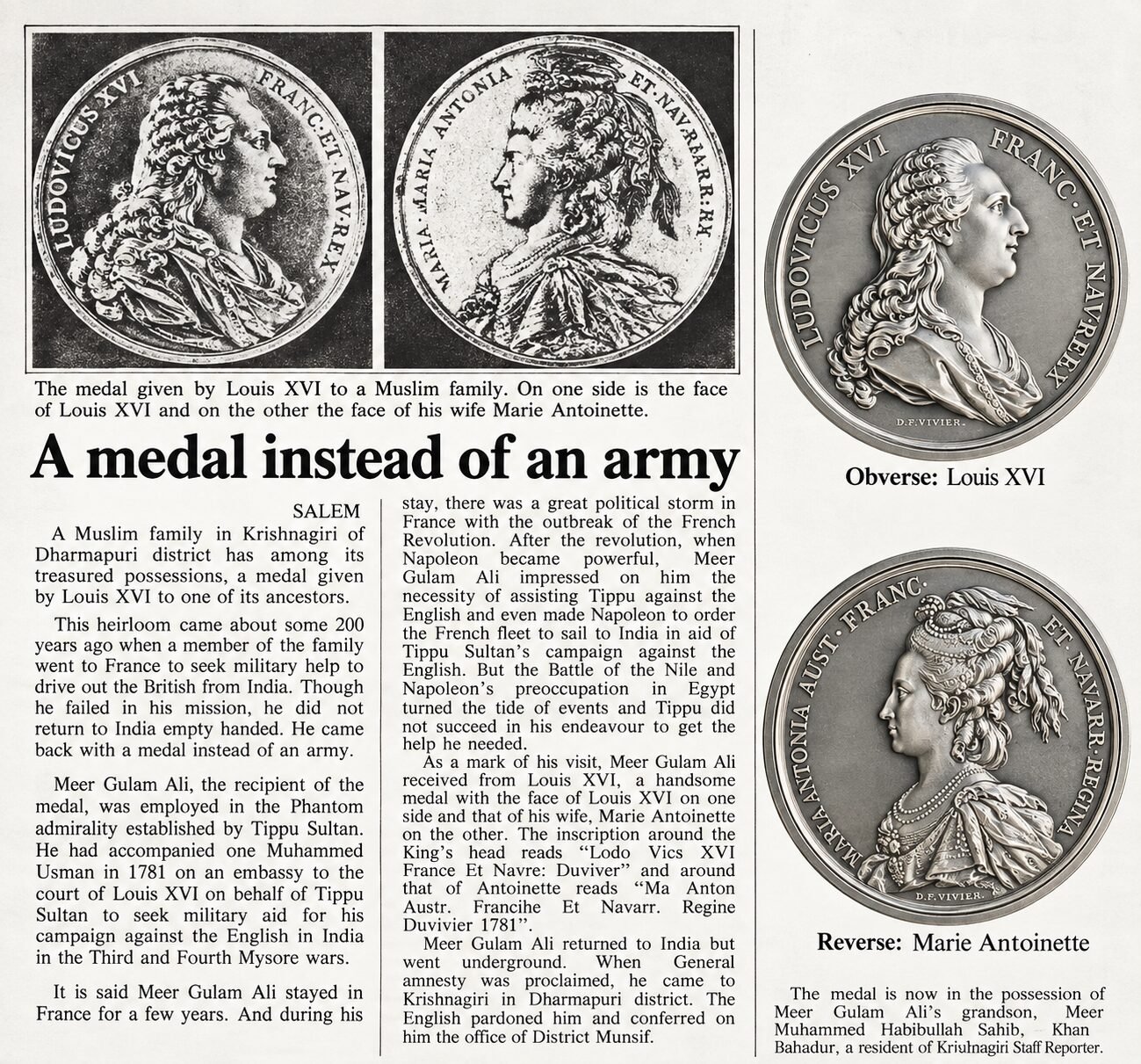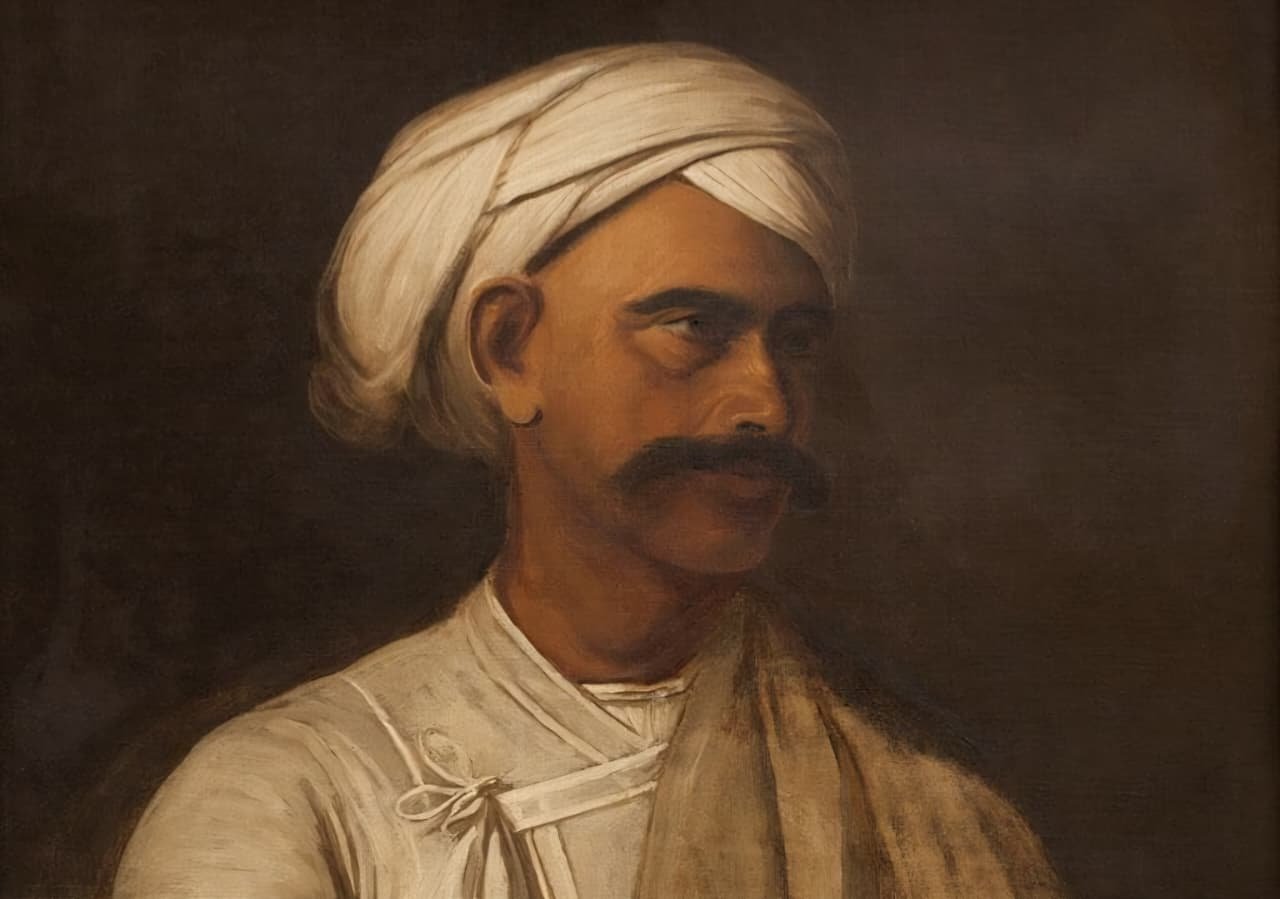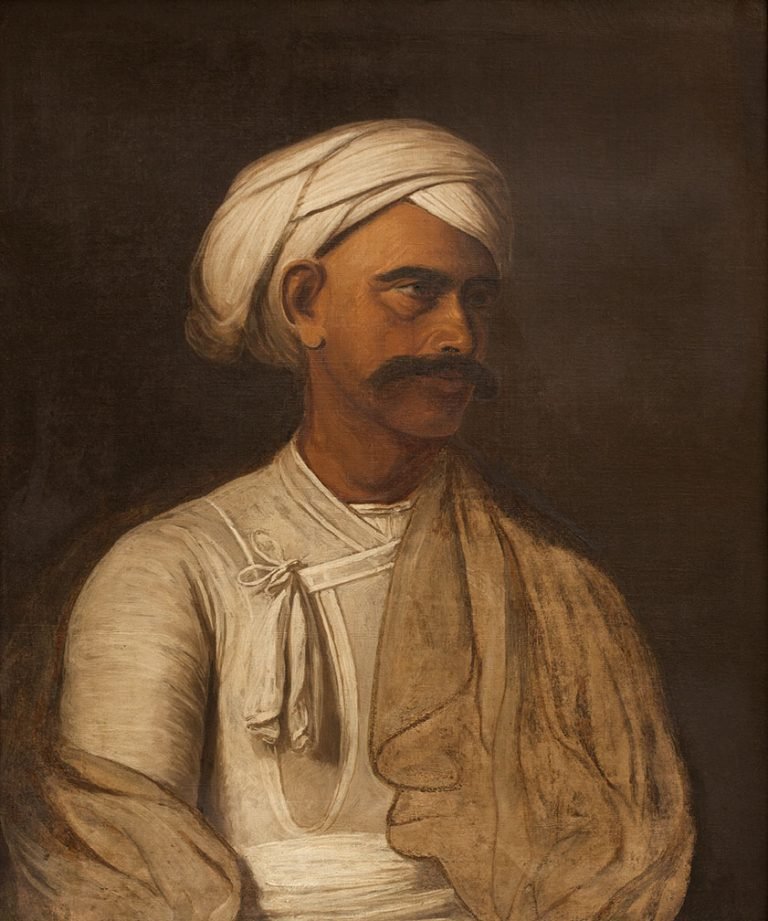
The Hindu recorded that Tipu Sultan’s trusted envoy Mir Ghulam Ali approached Napoleon for assistance against the British. Other historical records provide the wider setting for that account: a mission associated with Louis XVI, a surviving French royal medal, Tipu’s “phantom admiralty,” diplomatic operations conducted in strict secrecy, and his later connections with the ruling house of Arcot.
(RAHNUMA) Long before British supremacy in India appeared inevitable, Tipu Sultan was looking far beyond Mysore for allies capable of checking the expansion of the British East India Company. His diplomacy stretched across the Indian Ocean and into the courts and governments of the Ottoman and French worlds. One of the men entrusted with these sensitive undertakings was Mir Ghulam Ali Khan, a senior official and diplomatic representative of Tipu Sultan.
His remarkable French connection was recorded by The Hindu in an article memorably titled “A Medal Instead of an Army.” The newspaper reported that Mir Ghulam Ali travelled in connection with Tipu Sultan’s efforts to obtain French assistance against the British. It further stated that after the French Revolution, when Napoleon Bonaparte became powerful, Mir Ghulam Ali impressed upon him the necessity of assisting Tipu Sultan against the English. The account also linked these approaches with Napoleon’s plans for French intervention in the East.
That story becomes particularly interesting when read alongside older and independent accounts of Mir Ghulam Ali’s career.
The Salem District Gazetteer records that Ghulam Ali’s grandson, Mir Muhammad Habibulla Sahib Khan Bahadur of Krishnagiri, possessed a large medal connected with his grandfather’s mission, bearing representations of King Louis XVI and Queen Marie Antoinette.
The Gazetteer also preserved the tradition that Mir Ghulam Ali travelled on an embassy associated with the French court, journeying by way of Mauritius and the Cape of Good Hope, and that the mission remained in Paris for approximately a year. The Mysorean representatives received honours in France, although the army Tipu sought was not immediately secured. It is from this episode that the memorable expression “a medal instead of an army” emerges.
There is an additional and particularly unusual detail in the Salem District Gazetteer: it associates Mir Ghulam Ali with what it describes as the “phantom admiralty established by Tipu.”
That reference takes on greater meaning when placed beside what is known of Tipu Sultan’s deliberately concealed diplomacy with the French.
The distinguished historian Professor B. Sheikh Ali, in Tipu Sultan: A Crusader for Change, discusses Tipu’s renewed attempts to obtain French military intervention against Britain. Among the trusted men selected for a proposed mission connected with French-controlled Mauritius, Professor Sheikh Ali names Meer Ghulam Ali.
The instructions were explicit. The negotiations were to be undertaken “in the strictest secrecy.”
This was not intended merely as a ceremonial embassy. Tipu’s representatives were to discover the true intentions of the French, seek a substantial French army and fleet, and negotiate cooperation against British power. Tipu was prepared to bear the expenses of French troops employed in the enterprise, while the projected diplomatic network extended beyond Mauritius towards Paris.
This clandestine dimension matters when reading The Hindu’s account. Tipu Sultan’s relations with France were not conducted exclusively through conventional embassies whose movements and discussions would necessarily appear in ordinary diplomatic records. Some of his representatives were specifically instructed to conceal the nature of their work.
Mir Ghulam Ali, moreover, was not a marginal member of Tipu’s establishment.
The papers of Tipu Sultan published by William Kirkpatrick in 1811 as Select Letters of Tippoo Sultan establish Ghulam Ali Khan’s position among the Sultan’s trusted officials and diplomatic representatives. Professor B. Sheikh Ali also records the major Mysorean embassy sent in 1786, under Mir Ghulam Ali Khan’s leadership, towards the Ottoman world.
His standing was demonstrated again after the Third Anglo-Mysore War. Under the Treaty of Seringapatam in 1792, Tipu Sultan was compelled to surrender two of his young sons as hostages. Mir Ghulam Ali was entrusted with accompanying the princes. The well-known artistic representations of that painful episode therefore include a man who occupied a position of considerable confidence within Tipu Sultan’s diplomatic world.
Mission to the Ottoman Caliph
That Ottoman mission was itself an extraordinary undertaking. Professor B. Sheikh Ali records that Mir Ghulam Ali Khan headed an embassy of approximately one thousand people, which sailed from Mangalore on 10 March 1786 aboard four ships carrying valuable gifts and products of Mysore for the Sublime Porte. After an arduous journey through Muscat, Basra and Baghdad, the embassy eventually reached Constantinople in September 1787.
There, Mir Ghulam Ali and his fellow envoys were received at the court of the Ottoman Sultan and Caliph Abdul Hamid I. Tipu sought recognition of his sovereignty from the Ottoman Caliph, together with military assistance, craftsmen and technicians, and expanded commercial relations between Mysore and the Ottoman Empire.
Modern Ottoman archival research by historian Kahraman Şakul records that the embassy reached Istanbul on 25 September 1787 and that Abdul Hamid I granted Tipu a Caliphal investiture, recognising his position as a sovereign and permitting him to strike coins. Recent scholarship on the mission, including the study “Tipu and the Turks: An Islamicate Embassy in the Age of British Expansion,” similarly draws upon surviving Ottoman archival material and the Persian instructions issued to Ghulam Ali Khan and his fellow envoys.
The mission therefore placed Mir Ghulam Ali personally at the court of one of the most important Muslim sovereigns of his age, acting as Tipu Sultan’s representative before the Ottoman Caliph. His diplomatic world stretched from Mysore through the Persian Gulf and Ottoman Empire and, according to the accounts of his French activities, onward into Europe.
His standing was demonstrated again after the Third Anglo-Mysore War. Under the Treaty of Seringapatam in 1792, Tipu Sultan was compelled to surrender two of his young sons as hostages. Mir Ghulam Ali was entrusted with accompanying the princes. The well-known artistic representations of that painful episode therefore include a man who occupied a position of considerable confidence within Tipu Sultan’s diplomatic world.
The Arcot Connection
The history preserved within Mir Ghulam Ali’s family adds another dimension to his story. Following his return from his French mission, Mir Ghulam Ali married a daughter of the Nawab of Arcot from whom he fathered a daughter. She was married to Nawab Syed Arifullah Khan, son of the Chief Justice of Hyderabad, and grandfather of Syed Ahmed Mohiuddin and Syed Yusufuddin, founding publishers of Rahbar-E-Deccan. Family history further records that at a time when the British sought him, he concealed himself within the palace of the Nawab of Arcot.
The chronology places this tradition within an especially interesting period in the history of the Carnatic. Muhammad Ali Khan Wallajah, Nawab of Arcot, ruled until 1795 and was succeeded by his son Umdat-ul-Umara, who ruled until 1801. The Arcot court occupied a complicated position between the expanding power of the East India Company and the political world of southern India in which Mysore remained a formidable force.
The connection between Mir Ghulam Ali and the Arcot court was not confined to later family memory. Correspondence associated with the period records Umdat-ul-Umara communicating with Ghulam Ali Khan around 1792, at precisely the time when Tipu’s relations with the British and the Carnatic were extraordinarily sensitive. British authorities would subsequently investigate what they regarded as clandestine communications between the Arcot court and Tipu Sultan.
The family account of Ghulam Ali finding protection within the Nawab’s palace therefore belongs within a broader historical setting in which Tipu Sultan, Mir Ghulam Ali and the house of Arcot were already connected through the complicated diplomacy of southern India. His marriage into the Nawab’s family would have added a personal and dynastic dimension to those political connections.
From Louis XVI to Napoleon
Seen together, these accounts reveal a remarkable picture of Mir Ghulam Ali Khan’s place within Tipu Sultan’s international diplomacy.
The Salem District Gazetteer connects him with France, the court of Louis XVI, the French royal medal preserved by his descendants, and Tipu’s enigmatic “phantom admiralty.” William Kirkpatrick’s Select Letters of Tippoo Sultan establishes his importance among the Sultan’s trusted officials, while Professor B. Sheikh Ali records Meer Ghulam Ali among those selected for French negotiations expressly ordered to be conducted “in the strictest secrecy.”
It is against this background that The Hindu’s account of his contact with Napoleon assumes particular significance. The newspaper records that, following the French Revolution and Napoleon’s rise to power, Mir Ghulam Ali impressed upon Napoleon Bonaparte the necessity of assisting Tipu Sultan against the British.
The wider story reveals the remarkable geographical reach of Tipu Sultan’s diplomacy. His search for allies extended from the Ottoman world to the court of Louis XVI, French Mauritius and Revolutionary France, as Mysore sought soldiers, ships, weapons, craftsmen and political alliances capable of resisting British expansion.
Mir Ghulam Ali appears repeatedly within this diplomatic world: as a trusted representative of Tipu Sultan; as leader of an important overseas embassy; in connection with the Sultan’s secret French negotiations and “phantom admiralty”; as the official entrusted with accompanying Tipu’s hostage princes; through his marriage into the ruling family of Arcot and refuge within its palace; and, as recorded by The Hindu, in approaches to Napoleon Bonaparte himself.
Future discoveries in Indian, French or British archives may add further details to this extraordinary history. The sources already available, however, preserve a remarkable account of one of Tipu Sultan’s most trusted envoys standing at the intersection of Mysore, the Ottoman world, the Nawabs of Arcot, Louis XVI’s France, Tipu’s secret diplomatic and naval ambitions, and the continuing search for French assistance under Napoleon.
It is a story that deserves to be remembered—and one that invites historians to continue the search.