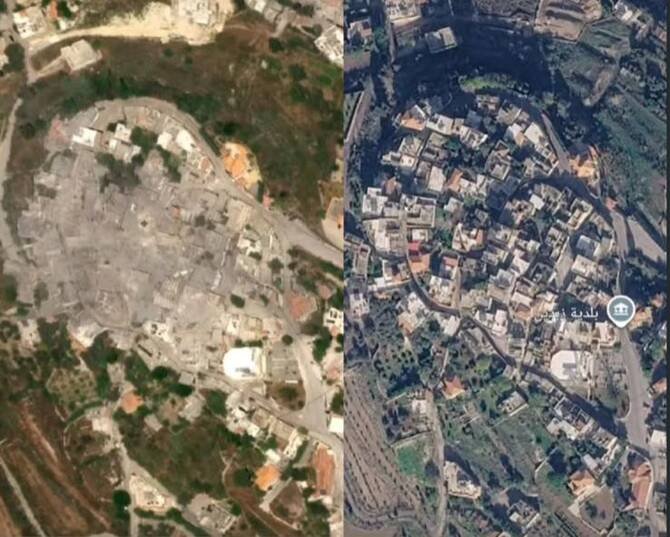
BEIRUT(RAHNUMA): Displaced residents of villages in southern Lebanon, who currently have no way of reaching their homes, are turning to commercial satellite imagery to learn whether the houses they fled are still standing.
For many families, the images offer the first glimpse of homes left behind during successive waves of displacement since Israel’s war on Lebanon began. Some pool money with neighbors to purchase the images, hoping to answer a question that has become an obsession: Is there anything left to return to?
The practice has spread across southern Lebanon as Israeli evacuation orders, continued military operations, and systematic destruction have left dozens of villages inaccessible to their residents.
Eighty-five villages have effectively been cut off since Israel’s incursions into southern Lebanon, which began in 2023 and intensified further in March. In April, Israel established what it calls a “Yellow Line” buffer zone extending between 1.2 and 12 kilometers north of the Blue Line.
Residents say information from the border is scarce, particularly since repeated attacks on ambulances and rescue teams have limited one of the few remaining sources of information from inside the restricted zone, which spans approximately 568 square kilometers.
“When people fled their villages in haste, they left behind all their belongings and memories,” Hawraa, a medical professional from the town of Zebdin in the Nabatieh district, told Arab News. “Our primary concern was escaping death and finding a safe place to shelter.”
As military operations intensified, residents’ anxiety about their homes grew.
“We began searching for any information we could find. Satellite images became one of the few available options after we started seeing them shared on social media, showing the extent of the destruction,” she said.
Hawraa turned to OnGeo, a satellite imagery platform, and found updated images of the village. She contacted fellow residents through a social media group and suggested that they pool their money to purchase the images.
“Some contributed $5, others $10, and we managed to raise $80. However, the images cost $130, so a well-off resident of the village covered the remaining amount,” she said. “We now have a means of checking on our homes.”
Hawraa said this method has become widespread in Lebanon and was already being used, albeit on a limited scale, during the last war to determine the fate of frontline villages that the Israeli army had effectively reduced to scorched earth.
Satellite images taken in early May revealed the systematic destruction of urban areas and the opening of military corridors. These corridors include a route passing through 19 towns in the Tyre district, 23 towns in Bint Jbeil, 25 in Marjeyoun, 11 in Hasbaya, 6 in Nabatieh, and one town in Rashaya.
Engineer Tariq Mazraani, from the border town of Houla, is the head of a group representing the displaced residents. He said he was able to return to his town and found his home in Houla completely destroyed when the ceasefire came into effect in 2024, while another house was reduced to ashes.
“I had planned to turn the latter into a museum, as it contained artifacts, rare books and documents about the history of the village and southern Lebanon,” Mazraani told Arab News.
His family relocated to Zawtar Al-Sharqiyah, which was also struck during the recent war, forcing them to move again, this time towards Beirut.
As an engineer who has built numerous homes and villas across the south, Mazraani said property owners often bring him satellite images they have purchased to determine whether their homes can still be restored.
“Images are not available for every area, as there are restrictions on what satellites are permitted to capture,” he said. “However, in the images I can review, it is immediately apparent when a structure has been completely destroyed.”
One such property belonged to his friend Mounir, 61, who owns a villa in Houla.
“When he asked me to analyze an image of his property, I could not bring myself to tell him that the house he had spent 40 years and his life savings building has been reduced to ashes,” Mazraani told Arab News. “Eventually, one his relatives conveyed the news to him, and when he called me again to confirm what he had heard, I told him the truth. He fell utterly silent, then dissolved into grief-stricken sobbing.”
The cost of obtaining a satellite image ranges between $130 and $170, although some people have said that prices have climbed as high as $200. Hawraa said that obtaining an image used to take 24 hours, but can now take up to two days.
“It is striking that people’s peace of mind has turned into a daily source of anxiety, even at a cost many can scarcely afford. Those whose homes survived one round of attacks now purchase updated images. This reflects a deepening sense of anxiety among people who have lost their security,” she told Arab News.
Hawraa noted that images currently being requested are of villages that have been recently cut off, such as Zawtar Al-Sharqiyah, Arnoun, kfar Tebnit and Yohmor. She added that some of the updated images show Israeli tanks inside the town of Yohmor, where the latest updates show that “Israeli forces have bulldozed (the) cemeteries, sparking widespread anger among people and reopening wounds that had yet to heal. Even the cemeteries no longer remain in the village,” Hawraa said.
Diana Moukalled, from Tebnine, told Arab News that the civil defense and paramedics were the main source of information about the fate of their homes, but after the targeting of paramedics, there were no sources left.
“My mother, my siblings and I learned of the destruction of our home in the village from the paramedics, who took pictures of the house my father built — now reduced to rubble — and sent them to us,” she said, adding that the family, dismayed, analyzed the photos intently, searching for any trace of the things they once owned and loved.
“My sister said, ‘Look, this is part of our swing that we used to race to sit on; the stones have crushed it.’ It was an attempt to process the loss,” Moukalled told Arab News.
“We sat crying and looking at each other, unable to speak. How can a family mourn its house? How can they hold a wake for walls? How can we believe that our home, in which we lived and which lived in us, has suddenly turned to ashes?”
After the previous war, her brother restored what Israel had destroyed as a tribute to their late father, she explained.
“But today, after the house was targeted, we have not succeeded in keeping that promise. The house has become rubble,” Moukalled said. “And today I understand that this, for us, was more than just a house; it was our home.”