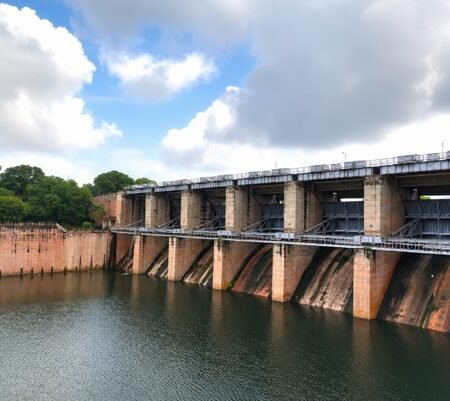
Jaipur, June 18 (IANS) Drought on one side and a reservoir full of water on the other, the irony captures the essence of the Panchna Dam controversy that has once again exploded into a major political and social flashpoint in eastern Rajasthan. What began as a dispute over irrigation water has now evolved into a complex political and social battle involving rehabilitation, compensation, community interests, court orders and political pressure.
The controversy, simmering for nearly two decades, has brought farmers onto the streets, drawn the attention of the Rajasthan High Court and prompted Rajasthan Minister Kirodi Lal Meena to issue a stern warning to the state government.
Located in Karauli district, the Panchna Dam was constructed between 1977 and 2004 to provide irrigation and drinking water to large parts of eastern Rajasthan.
However, while thousands of families lost land and homes to the project, many farmers who were promised irrigation benefits claim they have never received their share of water.
The dispute revolves around 74 villages. Farmers from 35 villages in Sawai Madhopur and Gangapur City districts, falling under the command area, allege that canal water has not reached their fields since 2006, leaving nearly 40,000 bighas dependent on rainfall.
On the other side are 39 villages in Karauli’s submergence zone, whose residents insist that canal gates should not be opened until pending issues of compensation, rehabilitation, employment and benefits under the Gudla-Panchna Lift Project are resolved.
The latest flashpoint emerged after farmers intensified their agitation.
Hundreds of protesters, including women, marched towards the Delhi-Mumbai railway line with tractors and heavy machinery, demanding immediate release of water.
The demonstrations triggered a large deployment of police and railway security personnel.
Political pressure mounted further when Minister Kirodi Lal Meena intervened directly.
After meeting Chief Minister Bhajan Lal Sharma, Meena claimed that the absence of irrigation water for nearly 20 years had caused losses of around Rs 4,000 crore to farmers and forced large-scale migration from the region.
He also warned that if water was not released in accordance with court directions, the Minister would consider resigning from the state Cabinet in support of the affected farmers.
The controversy has also drawn a response from senior Congress leader and former Deputy Chief Minister Sachin Pilot.
Calling for an immediate resolution, Pilot urged the Bharatiya Janata Party-led state government to initiate dialogue with all stakeholders and comply with the High Court’s directions.
“Water is a necessity for everyone, and under no circumstances should a situation arise that creates tension or weakens the spirit of brotherhood,” the Congress leader said.
He added that the Panchna Dam issue has remained unresolved because multiple stakeholders are involved, each with legitimate concerns.
“It is the responsibility of the state government to take all parties into confidence, establish dialogue and arrive at a solution while respecting judicial orders,” he said.
Amid rising tensions, Sawai Madhopur District Collector Kanaram said the administration is attempting to find a consensual solution.
He said a meeting was held under the chairmanship of the Divisional Commissioner, where it was decided that discussions would be held with representatives of both groups of farmers to explore a mutually acceptable resolution.
According to Kanaram, efforts are underway to defuse tensions and ensure that the issue is settled through dialogue rather than confrontation.
With Mahapanchayats being organised on both sides and pressure mounting from political leaders, the Panchna Dam dispute has reached a critical stage.
Whether the government succeeds in balancing the irrigation demands of farmers with the rehabilitation concerns of displaced villagers may determine the future of one of Rajasthan’s longest-running water conflicts.